by Mia Ilavska
October 12, 2026
On-Street vs Off-Street Parking: What You Need to Know Now
Off-street parking is parking away from the public road, in car parks and garages; on-street parking is along the kerb. What each term means, how they differ, and how cities manage both.
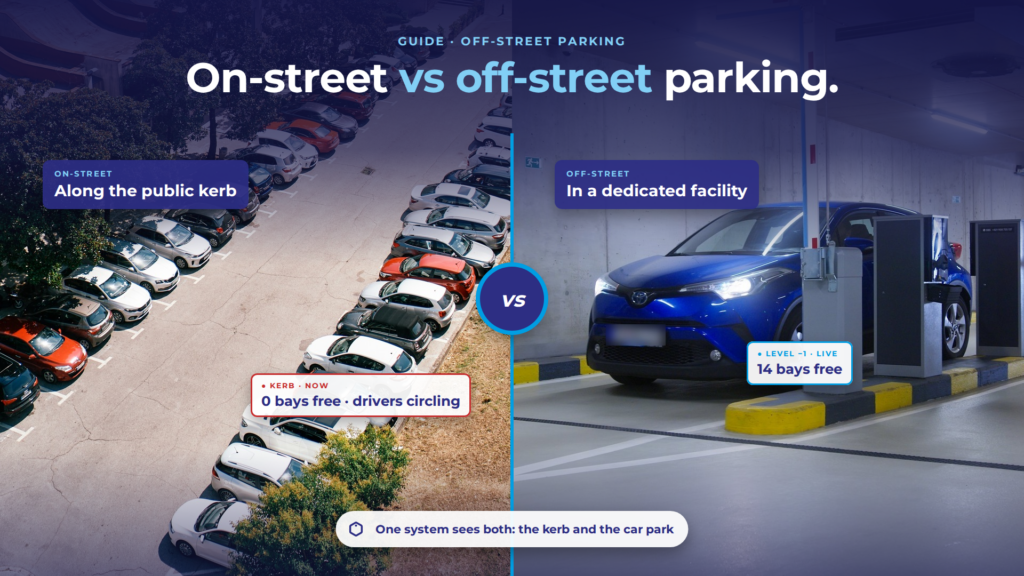
Table of content
What is off-street parking?
Off-street parking means parking that is not on the public carriageway. It includes surface car parks, multi-storey and underground garages, park-and-ride sites, and private or commercial lots attached to shops, offices and apartments. The defining feature is simple: the vehicle is parked off the road itself, usually in a dedicated facility with its own entrance.
On-street parking, by contrast, is parking in marked or unmarked bays along the kerb of a public street. It is the most visible kind of parking and usually the most fought over, because it is closest to the destination.
On-street vs off-street parking
The two serve different needs and are governed differently.
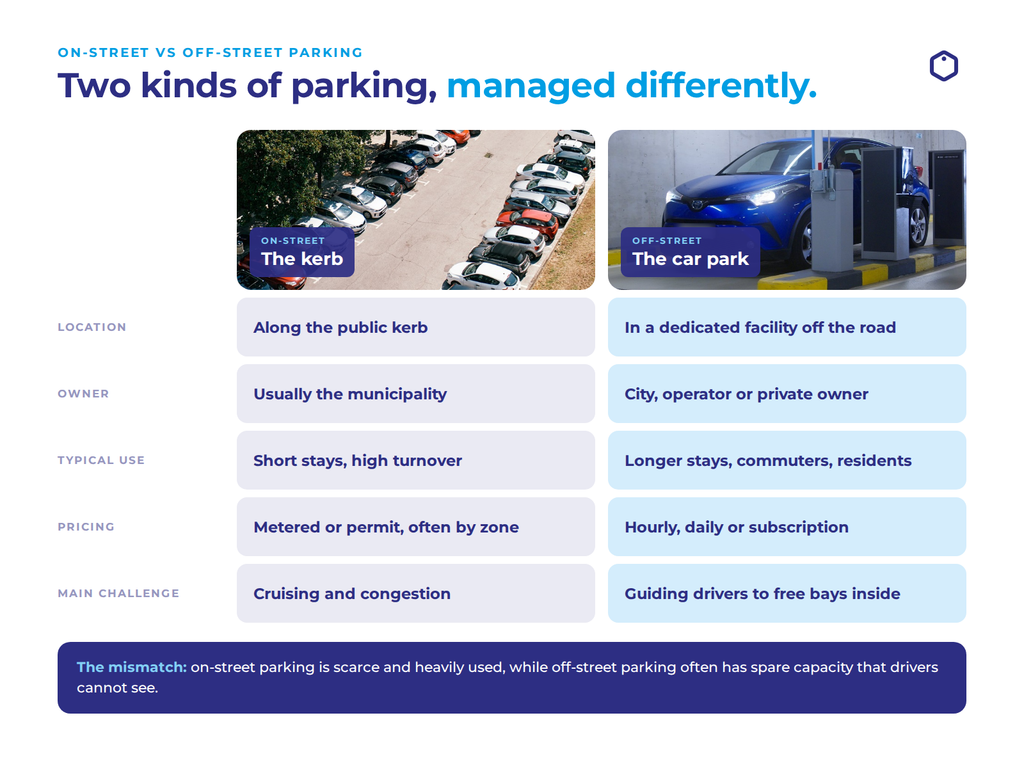
| On-street parking | Off-street parking | |
|---|---|---|
| Location | Along the public kerb | In a dedicated facility off the road |
| Owner | Usually the municipality | City, operator or private owner |
| Typical use | Short stays, high turnover | Longer stays, commuters, residents |
| Pricing | Metered or permit, often by zone | Hourly, daily or subscription |
| Main challenge | Cruising and congestion | Guiding drivers to free bays inside |
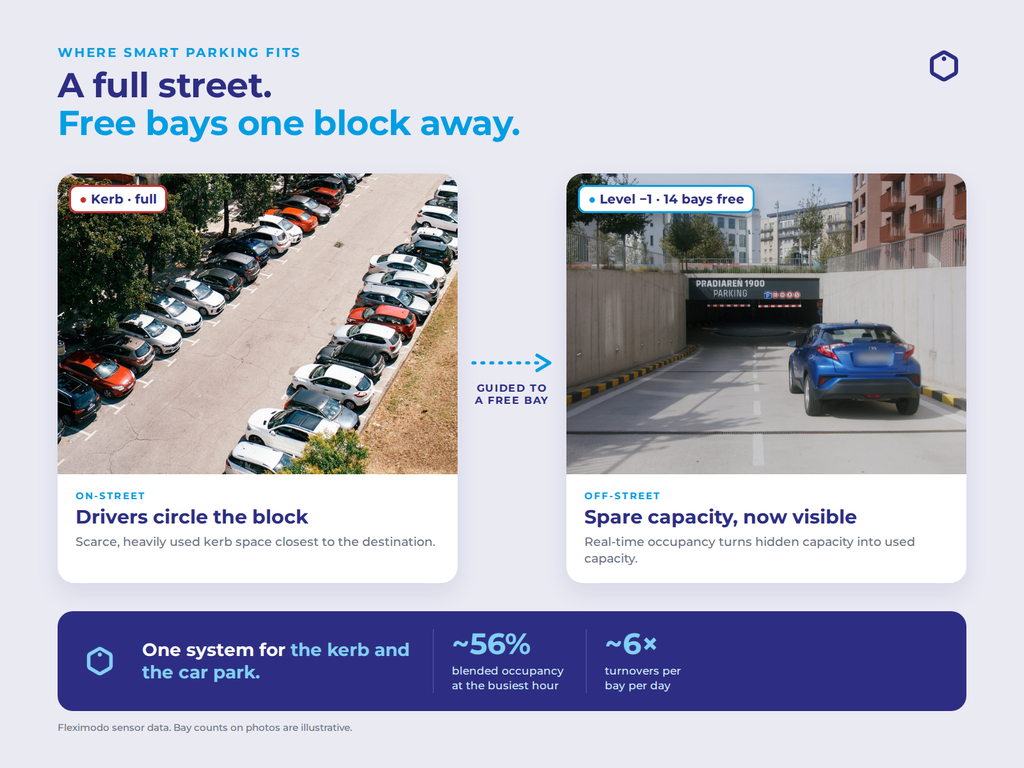
In most cities, on-street parking is scarce and heavily used, while off-street parking has spare capacity that drivers cannot see. That mismatch is why people circle a full street while a garage a block away sits half empty.
How cities manage on-street parking
On-street parking is about managing scarcity on the kerb. The tools are pricing and enforcement, and both work far better with data. Occupancy sensors show which bays are free in real time, feeding apps and signs so drivers stop circling. Dynamic pricing nudges the rate to demand so a space or two stays free on every block. Enforcement compares occupancy against payment and permits, so officers go where the problem is.
How cities manage off-street parking
Off-street parking is about guiding drivers inside a facility and using its capacity well. A smart parking garage uses per-bay sensors and guidance signage to point drivers to free spaces floor by floor, which turns spare capacity that was invisible into capacity that gets used. The same occupancy data drives access, payments and analytics.
Where smart parking fits
The thread across both is visibility. On-street and off-street parking fail for the same reason: a space exists, but the driver cannot see it. Real-time occupancy data fixes both, which is why cities increasingly manage the kerb and the car park from one system rather than two.
In our own sensor data, blended occupancy peaks at about 56 percent even at the busiest hour, and a monitored bay turns over around six times a day. In other words, most places have free spaces far more often than they feel they do. The job is to make those spaces visible, on the street and off it. See how that works at city scale on our municipal parking page, and the sensors behind it in IoT parking sensors.
FAQ
What is off-street parking?
Off-street parking is parking away from the public road, in a dedicated facility such as a surface car park, a multi-storey or underground garage, a park-and-ride site, or a private lot. The vehicle is parked off the carriageway rather than along the kerb.
What is the difference between on-street and off-street parking?
On-street parking is along the public kerb, usually municipal, short-stay and metered. Off-street parking is in a dedicated facility off the road, often used for longer stays, and priced hourly, daily or by subscription. On-street is managed for scarcity; off-street is managed for guidance and utilisation.
What are examples of off-street parking?
Surface car parks, multi-storey garages, underground garages, park-and-ride sites, and private or commercial lots attached to shops, offices and apartment buildings.
Is off-street parking cheaper than on-street?
It varies by city. On-street parking is often priced higher per hour in busy centres to discourage long stays, while off-street facilities offer daily and subscription rates that are cheaper for longer parking. The right comparison depends on how long you stay.
How do cities manage on-street and off-street parking together?
Increasingly from one system. Real-time occupancy data covers both the kerb and the car park, so drivers are guided to any genuinely free space and the city can price, enforce and plan across both from the same platform.
