by Mia Ilavska
July 30, 2026
How Smart Parking Protects Accessible Parking Bays
Accessible parking bays are among the most abused spaces in any car park. This is how smart parking verifies disabled bays in real time, cuts misuse, and keeps them free for the people who actually need them, without cameras.
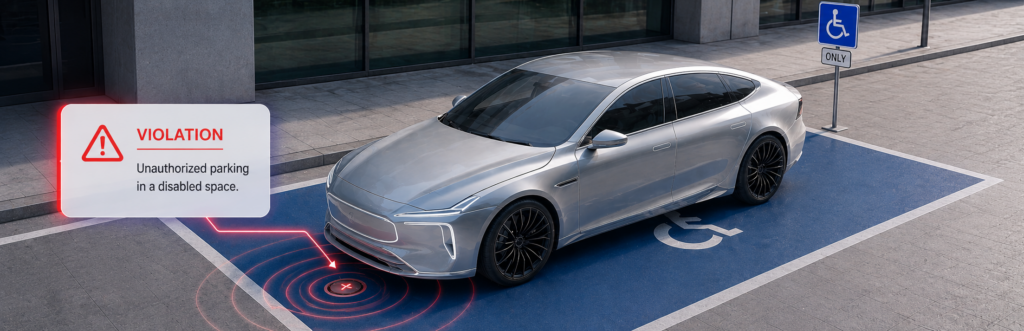
Table of content
Why accessible parking bays get misused
Accessible bays get misused because, without live monitoring, the risk of getting caught is low. Manual enforcement covers only a fraction of spaces at any moment, so a driver who parks in a disabled bay "just for five minutes" usually gets away with it. As a result, the people the bays exist for arrive to find them occupied.
The problem is not a lack of rules. It is a lack of eyes. A warden cannot watch every accessible bay across a city all day, and complaint-driven enforcement always arrives after the harm is done.
The scale is not trivial either. In the UK, councils issued more than 100,000 penalty notices for disabled-bay misuse and Blue Badge fraud in the 2024/25 financial year, and one county, East Sussex, estimated that around one in five Blue Badges in circulation is misused. Those are the cases caught or estimated; the ones nobody sees are the reason a wheelchair user arrives to a full bay.
How smart parking protects accessible parking
Smart parking protects accessible bays with two layers working together: detection and permission. A parking sensor detects when any vehicle occupies the bay, and a digital permit confirms whether that vehicle is authorised to be there. When the sensor reports "occupied" but no valid permit is present, the system flags a violation instantly.
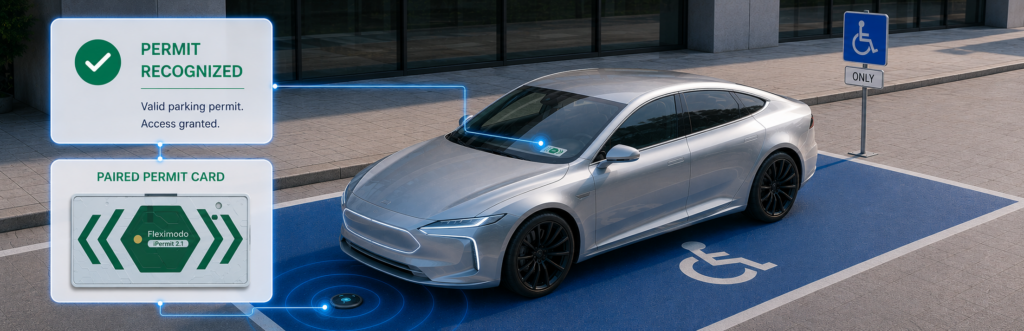
Because the two signals are checked together, enforcement stops being random. A warden is sent to a bay that is actually being misused, right now, instead of walking the lot on the off chance. Fleximodo sensors detect at 99.96 percent accuracy across 71,000+ deployments in 50+ countries, so the alerts operators act on are reliable.
Real-time enforcement without a camera
Accessible-bay enforcement is one place privacy matters most, and sensors handle it without filming anyone. A magnetometer-plus-radar sensor detects the mass of a vehicle, not a face, a plate, or a person in a wheelchair. So the system knows a bay is occupied and whether a permit is valid, but it never records who is parking.
That is a real advantage over camera-based enforcement. Cameras raise legitimate privacy questions in exactly the situation where dignity matters most. A sensor answers the only question that counts, is this bay being used correctly, and nothing else.
A real deployment: accessible-bay enforcement in Trikala, Greece
Two Greek cities show how this looks in practice, each solving a different piece of the accessible-parking puzzle.
Trikala, a city of 75,000, built accessible parking into a wider smart city programme rather than bolting it on afterwards. The deployment runs three enforcement use cases on one system: accessible parking bays with IoT Permit Cards and automated violation alerts, time-limited zones with 20-minute overstay detection, and pedestrian-crossing zones that trigger an enforcement notification after a 7-minute tolerance. Permit Cards were white-labelled with the City of Trikala logo, and the CityPortal platform was configured to the municipality's own enforcement workflow, giving officers real-time visibility and automated enforcement triggers across every monitored zone. Trikala's smart parking programme, built on Fleximodo's IoT sensors, won the Gold Award in the Smart Parking category at Greece's Mobility Awards, with the city reporting a 32% drop in congestion and a 50% gain in parking availability since launch.
Chania, on the island of Crete, took a narrower but no less effective approach: real-time occupancy monitoring across the city's accessible parking bays. Fleximodo's ground sensors were paired with Bluetooth-enabled permit cards, delivered together with network partner OTE/COSMOTE over NB-IoT, letting traffic police see instantly whether a bay is legally or illegally occupied. Within a year of going live, illegal occupation of accessible bays dropped by more than 60%. The deployment earned Chania a special mention at the European Commission's Access City Award 2020, recognised specifically for "employing ICT to provide accessible parking and prevent fraud.
What cities and operators gain
Protecting accessible bays is the right thing to do, and it also pays off operationally. Cities cut complaints from residents and advocacy groups, because the bays are actually available. Operators show provable, consistent enforcement, which matters for compliance and public trust. And nobody has to justify a camera watching a disabled bay, because there is not one.
For the wider city picture, see how this fits municipal parking, and how automated checks work across a whole site in parking enforcement.
FAQ
How does smart parking stop people misusing accessible bays?
An IoT sensor detects when a vehicle occupies the accessible bay, and a digital permit confirms whether it is authorised. If a car parks with no valid permit, the system flags a violation in real time and alerts the enforcement team, so misuse is caught in minutes instead of on the next patrol.
Does accessible-parking enforcement need cameras?
No. Fleximodo sensors detect a vehicle magnetically, not visually, so they never record a face, a plate, or a person. The system confirms whether a bay is occupied and whether the permit is valid, which is all enforcement needs, while protecting the privacy of disabled drivers.
How accurate is the detection?
Fleximodo sensors reach 99.96 percent detection accuracy by combining a magnetometer with a radar confirmation, verified across 71,000+ sensors in 50+ countries. Accurate detection is what makes real-time accessible-bay enforcement fair and reliable.
Can it work on residential streets, not just car parks?
Yes. In Skalica, accessible bays in residential areas were instrumented specifically so misuse could be verified instantly, in places a warden rarely reaches. Battery-powered wireless sensors need no cabling or mains power, so they suit scattered on-street bays.
Does this replace enforcement officers?
No, it directs them. Instead of patrolling on the off chance, officers are sent to bays that are actually being misused right now. The same occupancy data also supports permit management and reporting.
