by Mia Ilavska
October 6, 2026
Fleximodo vs Nwave: IoT Parking Sensor Comparison
Table of content
Fleximodo vs Nwave: side-by-side comparison
| Criteria | Fleximodo | Nwave |
|---|---|---|
| Detection accuracy | 99.96%, measured across 71,000+ live sensors | 99.7% published, up to 99.9% in per-space mode |
| Detection technology | Magnetometer + nanoradar (dual confirmation) | Magnetometer + proximity + temperature (multi-sensor) |
| Battery life | Up to 10 years | Up to 10 years (@20 sessions/day) |
| Connectivity | NB-IoT, LoRaWAN, Sigfox, LTE-M | LoRaWAN, Sigfox, proprietary Weightless-N |
| NB-IoT support | Yes, no gateway infrastructure required | Not offered (LoRa-band radio) |
| Signage | Solar flip-dot displays (reflective, no grid) | Wireless RGB LED message signs |
| Permit enforcement | BLE/UWB electronic permit cards (no camera, GDPR-friendly) | SecurePark ID (vehicle identification) |
| Temperature compensation | Automatic (ATC), validated −40°C to +85°C | Not prominently specified |
| Ingress protection | IP68 | IP68 |
| Installation format | In-ground and surface-mount | Surface-mount (20 mm profile) |
| Platform | ParkingAround + CityPortal | Nwave Analytics Dashboard |
| Live sensors deployed | 71,000+ across 50+ countries | Not publicly disclosed |
| GDPR, sensor layer | No personal data (magnetometer) | No personal data (magnetometer) |
Detection accuracy
Accuracy is the specification that matters most in a parking sensor. An inaccurate sensor generates false enforcement alerts, misdirects guidance signs and produces unreliable occupancy data.
Both vendors publish very high accuracy, so the number alone does not separate them. Nwave's datasheet lists 99.7 percent, rising to 99.9 percent in per-space mode, using a magnetometer paired with proximity and temperature sensing and noise-filtering algorithms that help it ignore pedestrians. Fleximodo publishes 99.96 percent.
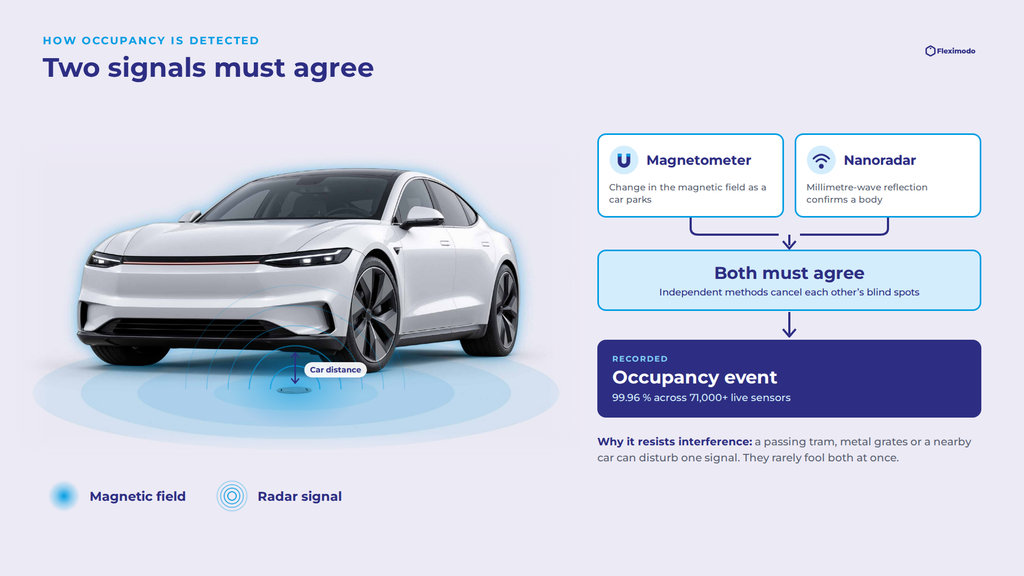
The distinction worth weighing is how each number is produced and verified. Fleximodo's figure is measured across more than 71,000 live sensors in real deployments rather than taken from a lab datasheet, and it comes from dual confirmation: a magnetometer detects the magnetic disturbance of a parked vehicle, and a nanoradar confirms it with a millimeter-wave reflection, so both signals must agree before an occupancy event is recorded. That second, independent signal adds resilience in interference-heavy sites such as underground car parks, busy streets and areas near public transport. For most buyers the practical question is less the third decimal place and more whether a vendor can show its accuracy at the scale of your deployment.
Connectivity
In Fleximodo vs Nwave, connectivity is the second major procurement decision: it drives infrastructure cost, coverage and vendor dependency.
Fleximodo uses widely adopted protocols, with NB-IoT as the standout for Europe:
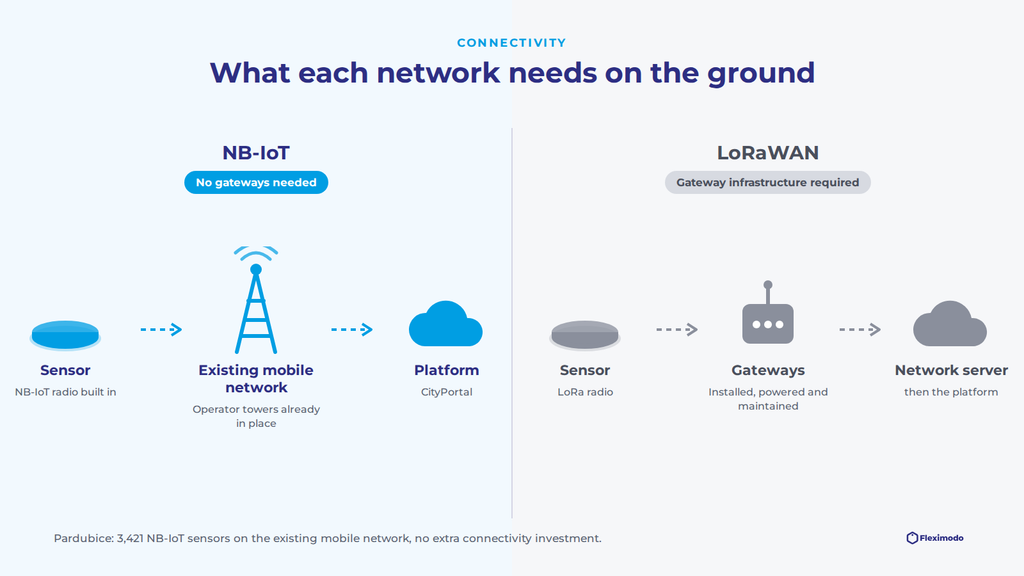
- NB-IoT: runs on existing cellular networks, so no gateways are needed and coverage reaches wherever there is mobile signal, including underground. Pardubice deployed 3,421 NB-IoT sensors on the city's existing mobile network with no additional connectivity investment.
- LoRaWAN: standard open protocol, used where a city already runs its own network, such as Ulm, Germany.
Nwave supports LoRaWAN and Sigfox, plus its own Weightless-N, a proprietary standard. A proprietary protocol introduces vendor dependency: the gateways that carry Weightless-N are specific to Nwave, so switching sensor vendors later can mean replacing gateway infrastructure. For most European municipal deployments, NB-IoT is the more practical route because mobile coverage is comprehensive and no new network has to be built, which is a direct operational advantage for Fleximodo's IoT parking sensors.
Signage and enforcement
Both vendors offer digital guidance signage, of different kinds. Fleximodo uses solar-powered flip-dot displays, which are reflective, stay readable in direct sunlight and draw very little power, so they can run without a grid connection. That suits sun-exposed and off-grid outdoor sites. Nwave uses wireless RGB LED message signs, which suit sites that want full-color, animated wayfinding.
On enforcement, Fleximodo adds BLE/UWB electronic permit cards that confirm an authorized vehicle without a camera or any personal data, a useful GDPR property for resident and accessible-bay schemes. Nwave offers SecurePark ID for vehicle identification.
Fleximodo vs Nwave: which to choose
- Choose Fleximodo for European municipal deployments that want NB-IoT with no new network, accuracy proven across a large live fleet, solar flip-dot signage and camera-free permit enforcement.
- Choose Nwave where LoRaWAN or Sigfox is already in place, full-color LED signage is preferred, and the deployment fits their platform.
Hold both vendors to the same test: ask for a verified accuracy figure with the method behind it, and for named references at a scale similar to your project.
FAQ
Is Fleximodo or Nwave more accurate?
Both publish very high figures: Nwave lists 99.7 percent (up to 99.9 percent per-space) on its datasheet, and Fleximodo publishes 99.96 percent measured across 71,000+ live sensors. The more useful difference is verification and method: Fleximodo's number is from real deployments at scale and uses a magnetometer plus a nanoradar for dual confirmation, which helps in interference-heavy sites.
What is the main difference between Fleximodo and Nwave?
Detection method and connectivity. Fleximodo confirms occupancy with a magnetometer and a nanoradar and supports NB-IoT with no gateways. Nwave uses a magnetometer with proximity and temperature sensing and runs on LoRaWAN, Sigfox or its proprietary Weightless-N.
Does Nwave support NB-IoT?
Based on its published specifications, Nwave operates on LoRa-band radio (LoRaWAN, Sigfox, Weightless-N) rather than cellular NB-IoT. Fleximodo supports NB-IoT, which needs no additional gateway infrastructure where mobile coverage exists.
Which is better for European cities?
For most European municipalities, NB-IoT is the practical choice because mobile coverage is comprehensive and no new network is required, which favors Fleximodo. Where a city already operates LoRaWAN, either vendor can use it.
Are Fleximodo and Nwave sensors GDPR-compliant at the sensor layer?
Yes for both. Both detect vehicles magnetically and record no personal data at the sensor. Fleximodo's permit enforcement also avoids cameras, using BLE/UWB permit cards instead.
Sources
- The Things Network device repository: Nwave Smart Parking Sensor G4 SM (99.7% detection accuracy, LoRaWAN)
- Nwave FAQs (99.9% accuracy in per-space mode)
- The Things Network device repository: Nwave Technologies devices
