by Mia Ilavska
October 8, 2026
Disability Parking Permit Fraud: Why a Photocopy Can Still Pass as a Permit
A disability parking card behind a windscreen proves surprisingly little on its own. The ways permits get misused, why patrols and scan cars leave gaps, and what cities should ask before the European Parking Card arrives.

Table of content
Key numbers at a glance
| Finding | Number | Source |
|---|---|---|
| Parked vehicles displaying a disability card in Paris vs. estimated share of Parisian drivers holding one | ~13% vs. ~6.7% | France 2 investigation (2018) |
| Drivers booked in Cyprus for parking in spaces reserved for disabled people | 2,965 of 3,574 recorded parking offences (~83%) | Cyprus Police figures reported by Cyprus Mail (2015) |
| Estimated share of unjust Dutch scan-car parking fines | ~1 in 10, out of 3–5 million fines a year | Dutch Data Protection Authority (2026) |
| Deadline for EU Member States to transpose the European Parking Card directive | 5 June 2027 (rules apply from 5 June 2028) | Directive (EU) 2024/2841 |
Disability parking permit fraud exploits a simple weakness: a card that looks valid is not necessarily being used lawfully.
A visual check can catch an obviously missing permit or an expiry date. It is less useful when the card is a convincing copy, has been revoked, or belongs to someone who is not using the vehicle. Those problems need different checks. Treating them as one problem makes it easy to buy a system that solves the wrong one.
How big is the problem?
The available figures show why cities should take misuse seriously. They do not provide one reliable, Europe-wide fraud rate.
A 2018 France 2 investigation reported that around 13% of parked vehicles in Paris displayed a disability parking card, compared with an estimated 6.7% of Parisian drivers holding one. That discrepancy raised concerns about misuse. It did not establish that half the displayed cards were fraudulent: parked vehicles and drivers are different populations, and a cardholder can also travel as a passenger.
Cyprus provides a different kind of evidence. In 2015, police booked 2,965 drivers for parking in spaces reserved for disabled people, out of 3,574 parking offences recorded in the figures reported by Cyprus Mail. That is approximately 83% of that recorded total — not 83% of every parking violation taking place across the country.
These figures describe different things: a discrepancy in card display in Paris and detected parking offences in Cyprus. Neither should be presented as a count of counterfeit permits.
The practical question for a city is more local: how often are its accessible bays occupied without a valid entitlement, and how reliably can its enforcement tools recognise legitimate users?
The five ways permits and enforcement go wrong
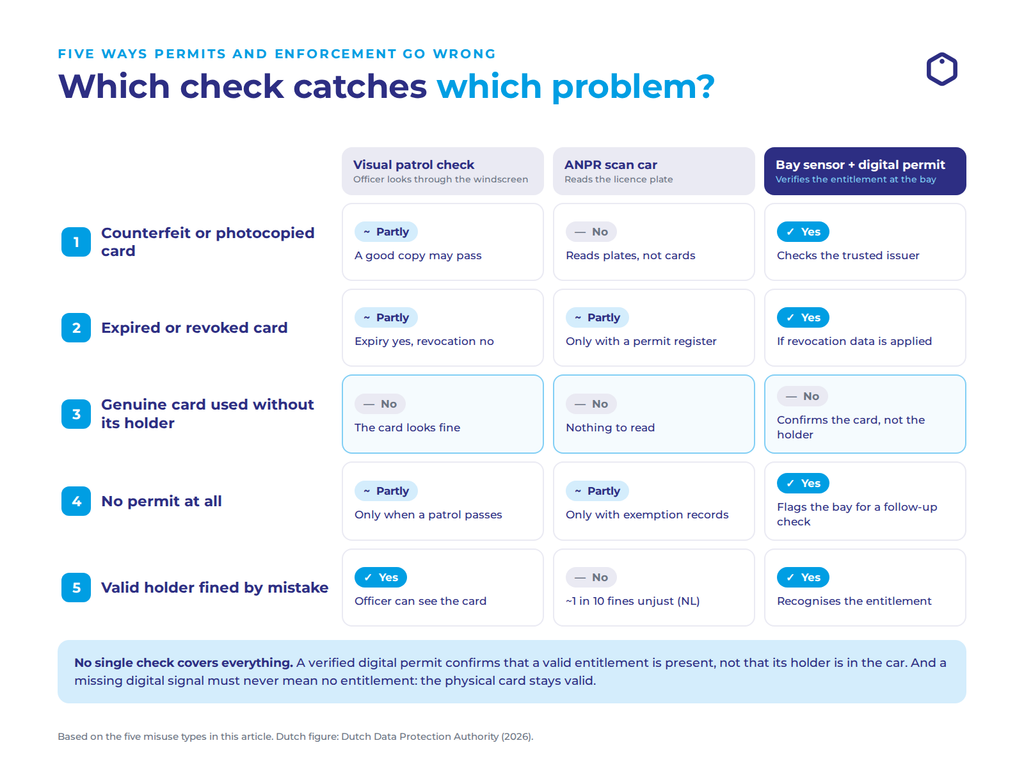
Disability parking permit misuse is not one problem. It is several, and each needs a different kind of check.
1. Counterfeit and photocopied permits
A convincing copy may pass a quick look through a windscreen. Visual inspection alone does not authenticate a card.
A cryptographically verifiable credential offers a stronger check: the verifier can establish whether the entitlement was issued by a trusted authority, rather than judging whether the card looks official. This is one of the design principles in our Policy Paper on the Digital European Parking Card.
2. Expired, revoked or deceased-holder permits
An expiry date can be visible on the card. Revocation is different: a genuine card may look unchanged after the entitlement has been withdrawn.
Digital verification can support current validity checks, provided the system receives and applies the relevant expiry and revocation information. Our Policy Paper proposes this as part of the digital entitlement layer.
3. A genuine permit used without its holder
The card is real. The entitlement is active. The person entitled to use it is not using the vehicle.
This is a separate problem from counterfeiting. Confirming that a valid card is present does not, by itself, confirm that its holder is present. Our project proposal identifies this misuse scenario, but cities should not assume that card-and-sensor verification alone resolves it.
4. Occupying a reserved bay without a permit
A driver takes the bay “for two minutes” and hopes nobody checks.
Occupancy sensors can show when a bay is taken. Adding permit verification can show whether a recognised digital entitlement is present. The important safeguard is what happens when there is no digital signal: a visitor may still hold a valid physical card. Our Policy Paper therefore argues against digital-signal-only enforcement.
5. Valid holders fined by mistake
Enforcement can fail in the other direction.
The Dutch Data Protection Authority reports that scan-car enforcement produces an estimated 3–5 million parking fines annually. Its 2026 findings, cited in our Policy Paper, put the unjust-fine share at roughly one in ten and identify disability cardholders as particularly affected when their parking entitlement is not recognised through the licence plate.
A fair system needs to do both jobs: identify misuse and protect valid users from incorrect fines.
Why patrols and scan cars leave gaps
Manual enforcement depends on an officer reaching the bay while the vehicle is there, then deciding what the displayed card proves.
That is useful for an absent card or visible expiry date. Authenticity, revocation and use without the holder may require additional checks. A quick look cannot answer every question.
Scan cars bring scale, but ANPR reads licence plates. It does not, on its own, authenticate a disability parking card behind the windscreen.
This does not make scan cars useless. It makes integration important. A system needs a reliable way to recognise parking exemptions before issuing a fine — whether through a permit register, a verified credential or an appropriate follow-up process. Paris, for example, provides Handi’Stat registration and a Ticket HANDI mechanism to help recognise eligible parking.
The goal is not simply more checks. It is checks that understand the entitlement.
Why higher fines are not enough
On 11 April 2024, Cyprus’s Parliament rejected a proposal to raise the fine for unauthorised parking in accessible spaces from €300 to €500. The vote was 35 against, four in favour and one abstention. Opponents argued that existing penalties were already substantial and that additional compliance measures were needed.
That does not prove higher fines never work. It shows why fines are only part of the answer.
Research summarised by the US National Institute of Justice finds that the certainty of being caught is a stronger deterrent than the severity of punishment. A larger penalty is less useful when drivers expect their misuse to go unnoticed.
For cities, the practical lesson is straightforward: improve the reliability of detection and the enforcement response, not just the number printed on the penalty notice.
What the European Parking Card changes — and what it does not
Directive (EU) 2024/2841 establishes a standardised European Parking Card for persons with disabilities. Member States must transpose the directive by 5 June 2027 and apply the rules from 5 June 2028.
The physical card must include a QR code and other digital features intended to prevent and combat fraud, with technical requirements developed through delegated acts. A digital version of the parking card remains optional for Member States.
That creates a stronger basis for verification. It does not make every enforcement gap disappear.
Three distinctions matter:
- A QR code needs a verification process. Scanning a code is not the same as checking authenticity, current validity and lawful use.
- A valid card does not establish the holder’s presence. Borrowing an authentic card remains a different problem from copying one.
- Verification needs to reach enforcement systems. A valid entitlement cannot prevent an incorrect automated fine if the system issuing that fine never checks it.
The card creates the foundation. Cities still need the workflow.
What a fraud-resistant system needs
Our Policy Paper proposes treating the digital EPC as a verification layer, not merely a digital image of the physical card. The physical card remains the fallback; the digital layer helps authorised systems check an entitlement without unnecessary disclosure.
Five principles matter most.
Verify the entitlement where parking happens
Connect occupancy information with permit verification. A city should know more than “this bay is occupied”: it should be able to establish whether a recognised entitlement is present, or whether further checking is needed.
Check authenticity and current validity
A useful digital credential should support trusted issuance, expiry and revocation checks. Proximity protocols should also address relay attacks, where a genuine token’s signal is retransmitted to another location.
That is different from someone physically borrowing an authentic card. The two scenarios should not be confused.
Add no unnecessary task for the holder
If every parking event requires opening an app, scanning a code or tapping a terminal, the system may introduce another accessibility barrier.
Our Policy Paper recommends passive, zero-interaction verification as a design requirement, with equivalent options for people who do not use smartphones.
Minimise the data disclosed
The enforcement question is usually whether a valid parking entitlement is present — not the holder’s diagnosis.
Our proposed architecture uses selective disclosure and changing BLE pseudonyms to minimise what is revealed at the kerbside. That is a design approach, not a reason to skip the wider GDPR assessment of issuance, registers, identifiers and enforcement records. The project proposal explicitly recognises that the broader system processes personal and special-category data.
Keep the physical card usable
No digital signal must not automatically mean no entitlement.
Visitors from physical-only schemes need a fair verification path. Our Policy Paper recommends accepting the physical card and its verification features as a permanent part of the system, not a temporary exception.
Five questions to ask before June 2027
If you manage parking, mobility or innovation in a European city, start here:
- How many accessible bays do you have, and how do you measure unauthorised occupation?
- Can your enforcement tools check permit authenticity and current validity, rather than only recognise a licence plate?
- How do you prevent incorrect fines for legitimate holders, including passengers and visitors?
- Does your next tender distinguish existing capabilities from future EPC compatibility?
- What happens when a valid physical card is present but no digital signal is detected?
The transposition deadline is 5 June 2027. The rules apply a year later. That gives cities a planning window — not a reason to label an untested integration “EPC-ready”.
How Fleximodo approaches it
Fleximodo combines bay occupancy detection with digital permit recognition. Our Policy Paper reports approximately 2,200 IoT bay sensors operating alongside roughly 2,000 iPermit digital cards across Pardubice in the Czech Republic and Prishtina in Kosovo.
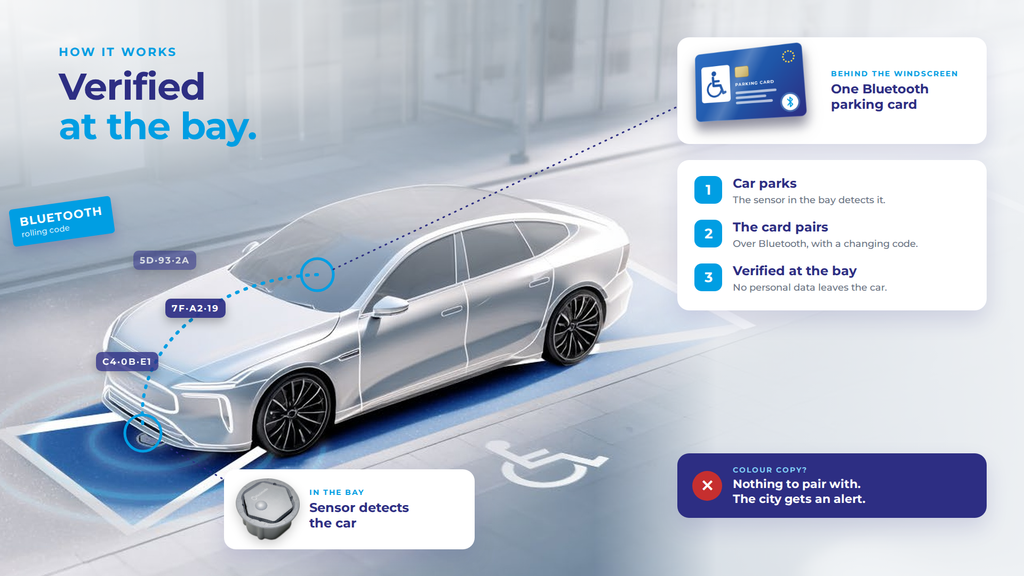
These deployments provide operating experience with the building blocks: sensors, digital permits and passive communication at the parking bay.
The complete European Parking Card architecture is a further integration step. Through Inclusive Parking 360, GOSPACE LABS and its partners propose combining these components with EUDI Wallet-linked credentials, privacy-preserving proximity verification and a cross-border verification SDK. The Policy Paper identifies pilots integrating the full stack as the initiative’s next phase.
The aim is not to claim that a sensor can prove everything. It is to make entitlement checks more reliable, reduce dependence on visual inspection and give enforcement teams better information — while preserving a fair route for physical-card holders.
For the technical and policy rationale, download our September 2026 Policy Paper, Design principles for the Digital European Parking Card, from our website. For the city-level workflow, see our accessible parking enforcement solution.
FAQ
How common is disability parking permit fraud?
Available evidence shows misuse and enforcement problems, but the figures cited here do not establish a single Europe-wide fraud rate. The Paris comparison concerns displayed cards and estimated cardholding; the Cyprus figures concern recorded parking offences. Neither is a direct count of counterfeit permits.
What types of misuse should cities distinguish?
Counterfeit cards, invalidated cards, authentic cards used without their holder, and parking without an entitlement require different checks. Relay attacks against digital tokens are another distinct technical risk. A system that handles one should not automatically be described as handling all of them.
Can ANPR scan cars detect fake disability permits?
ANPR alone cannot authenticate a displayed card. An enforcement system can, however, combine plate recognition with entitlement records, credential verification or follow-up checks. The important question is what the complete workflow verifies before issuing a fine.
Will the European Parking Card stop permit fraud?
It establishes a standardised card with digital anti-fraud features and a stronger basis for verification. It does not, by itself, prove the holder is present or ensure that every enforcement system checks the entitlement.
Can automatic bay verification detect a borrowed card?
Not necessarily. It can establish that a recognised digital permit is present, subject to the system’s validity checks. That is not the same as establishing that the authorised holder is using the vehicle. Cities need to keep that limitation clear when specifying and evaluating a solution.
