by Mia Ilavska
November 9, 2026
How a Parking Guidance System Works
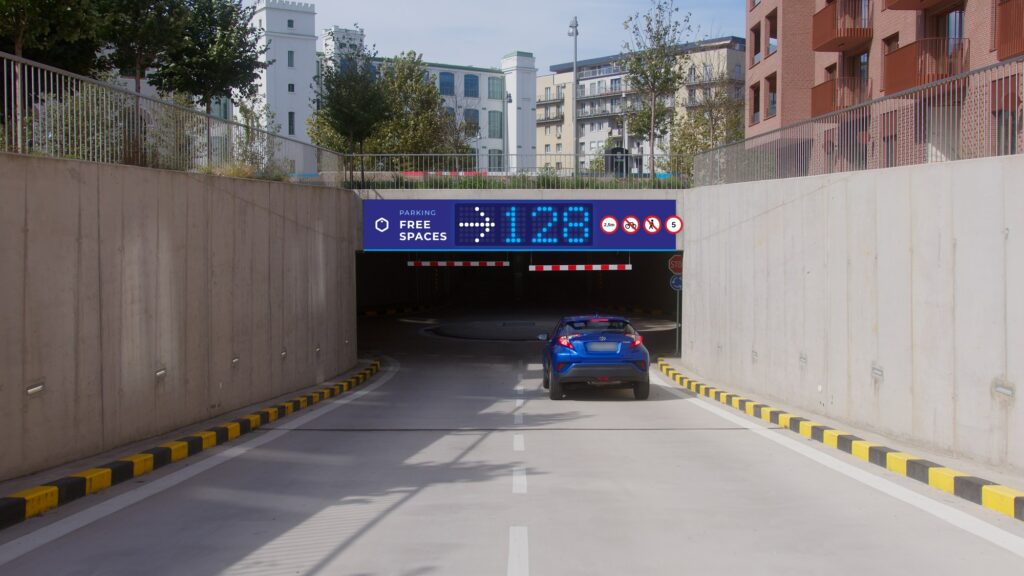
Table of content
The four steps
Every parking guidance system runs the same loop, whether it covers one garage or a whole district.
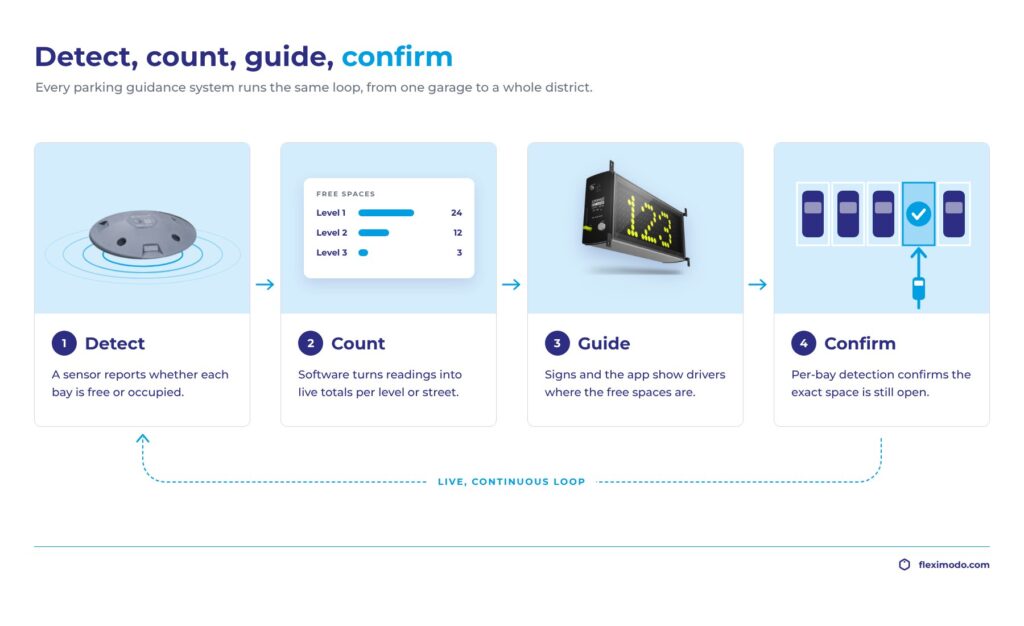
- Detect. A sensor reports whether each bay is free or occupied. Per-space sensors sit in or above the bay; counting sensors track vehicles in and out of a zone.
- Count. Software aggregates the readings into live totals for each level, street or section.
- Guide. Dynamic signs at entrances and decision points show how many spaces are free ahead, and an app routes the driver toward an open bay.
- Confirm. Because detection is per bay, the space a driver is sent to is confirmed open, not a stale count from a minute ago.
Counting versus per-space guidance
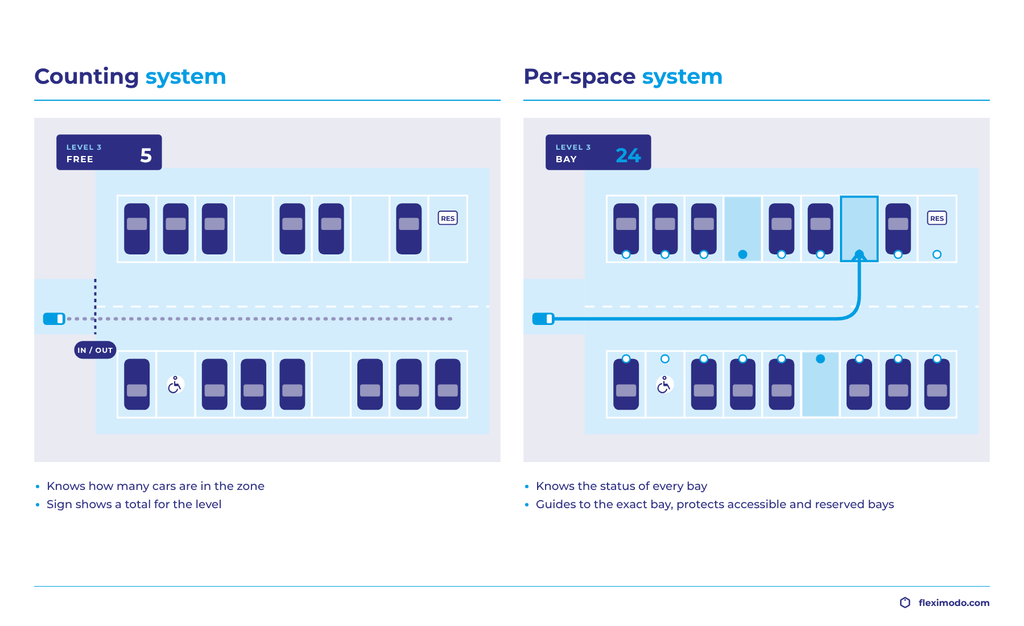
There are two levels of a parking guidance system, and they answer different questions.
A counting system tracks how many cars enter and leave a zone, so a sign can read “Level 3: 12 free”. It is cheaper and good for high-level direction. A per-space system knows the status of every individual bay, so it can direct a driver to the exact space, protect accessible and reserved bays, and produce bay-level analytics. Many sites combine the two: counting for the headline number at the entrance, per-space where accuracy and enforcement matter.
The components
Four parts make a parking guidance system work together.
Sensors. Reliable per-bay detection is the foundation. Fleximodo parking occupancy sensors detect at 99.96 percent accuracy, combining a magnetometer with nano-radar, and run on NB-IoT or LoRaWAN with no gateway in most countries.
Signage. On-site displays show availability where drivers decide. Fleximodo uses solar flip-dot parking guidance signage, readable in direct sunlight at a 160 degree angle, drawing power only when the number changes.
App and software. The platform aggregates every bay, drives the signs and the app, and stores the data for analytics, pricing and enforcement.
Permits. With IoT permit cards, the system knows who is authorised, which is what lets it guide a driver to their own space.
Guiding to the exact space
Most guidance stops at “there is a free space in this zone”. A per-space system can do more. Because it knows each individual bay and, with permit cards, who is entitled to it, the system can route a driver to the exact open bay, and for residents, staff or permit holders, straight to their assigned spot. That is the difference between pointing at a zone and finishing the journey.
In a multi-level garage this is what removes the full-loop search, level by level.
How to choose a parking guidance system
Four things decide whether a system holds up in the real world. Detection accuracy, because every direction depends on it. Outdoor readability, since a sign that washes out in sun guides no one. Power and cabling, where solar and no-gateway designs cut the install cost. And open APIs, so the system works with the gates, cameras and software you already run.
For the full Fleximodo capability, from the street to the exact space, see our parking guidance system, part of our wider smart parking platform. For the city-wide view, see urban parking guidance.
For more, see parking guidance signage.
Frequently asked questions
How does a parking guidance system work?
It detects free bays with sensors, counts the totals in software, and uses dynamic signs and an app to route drivers to an open space. Per-space systems can direct a driver to the exact bay.
What is the difference between counting and per-space guidance?
A counting system shows how many spaces are free in a zone. A per-space system knows each individual bay, so it can guide a driver to the exact space and support reserved and accessible bays.
What are the parts of a parking guidance system?
Per-bay sensors, guidance signage, an app and software platform, and optional permit cards that identify authorised drivers.
Can a parking guidance system guide a driver to their own reserved spot?
Yes. With IoT permit cards it recognises residents, staff and permit holders and guides them to their assigned bay.
