by Mia Ilavska
November 9, 2026
Urban Parking Guidance: How Cities Cut Cruising for Parking
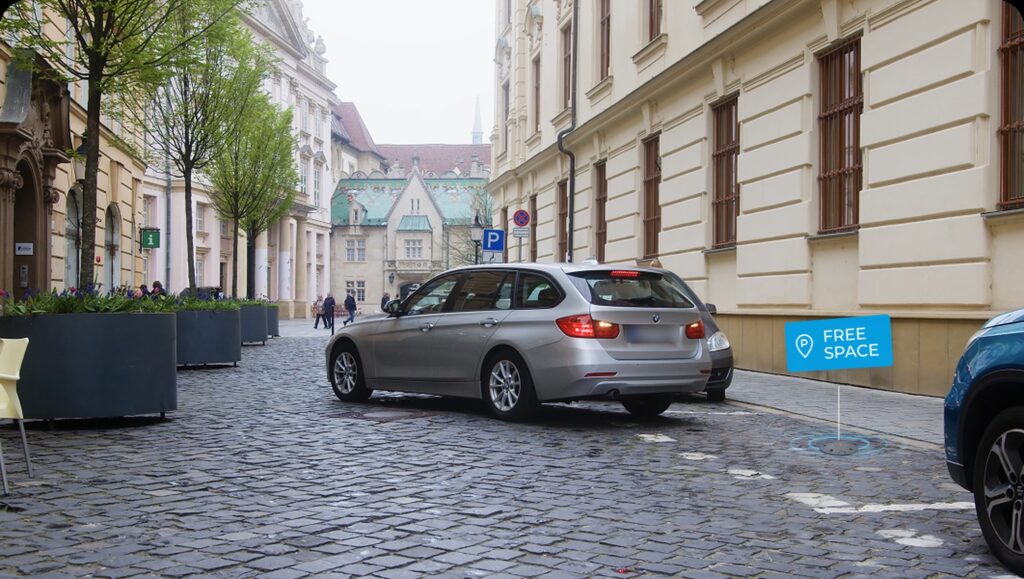
Table of content
Urban parking guidance is the use of real-time space data to send drivers straight to an open bay instead of letting them circle the block. For a city it is one of the cheapest ways to cut congestion, because a surprising share of downtown traffic is not travelling anywhere. It is just looking for a space.
Key takeaways
- Studies of busy districts attribute up to 30 percent of traffic to drivers cruising for a parking space.
- Urban parking guidance combines per-bay sensors, dynamic signs and an app to point drivers to a free space in real time.
- Outdoors, readability and power matter: solar flip-dot signs stay legible in direct sun where LED washes out.
- The same data that guides drivers also lets a city price and enforce by real demand. Pardubice raised parking revenue 74 percent with no tariff increase.
The hidden traffic cities pay for
Most congestion plans look at cars passing through. They miss the cars that have arrived and are now circling. Research in congested districts has attributed up to 30 percent of traffic to this cruising for a space. It burns fuel, clogs the curb lane and frustrates the people a city most wants downtown: shoppers, patients and visitors.
Cruising happens for one reason. A driver cannot see where the free space is. Urban parking guidance removes that blindfold.
What urban parking guidance is
Urban parking guidance is a system that detects which on-street or off-street bays are free and shows drivers where to go, in real time. It has three parts working together.
A per-bay sensor reports whether each space is free or occupied. Dynamic signs at junctions and zone entrances show how many spaces are free ahead. An app routes the driver to the nearest open bay. The better systems go one step further and guide a permit holder to their own assigned space.
The point is not the hardware. It is closing the gap between “there is a space somewhere” and “I can see where it is”.
How it cuts cruising
Guidance works at three moments in the drive.
Before the turn, a sign shows the driver which street or zone still has spaces, so they commit to the right area instead of guessing. On the way in, the app points them toward the nearest free bay. At the space, a sensor has already confirmed it is open, so the driver is not sent to a bay that filled thirty seconds ago. Each step removes a lap around the block.
For residents and permit holders, guidance also protects spaces. The system recognises who is authorised and keeps reserved and accessible bays available for the people entitled to them.
What makes on-street guidance actually work
On-street is the hard environment, and two things decide whether guidance holds up.
The first is the sign. A display on a sunlit street has to be read at a glance from a moving car. Solar flip-dot signs stay sharp in direct sunlight and offer a 160 degree viewing angle, where a conventional LED display washes out and draws far more power. Because they are solar and need no cabling, a city can deploy them across zones without trenching the street.
The second is the detection. Guidance is only as good as the data under it. Fleximodo parking sensors detect occupancy at 99.96 percent accuracy and run on existing NB-IoT networks, so in most countries there is no gateway to install or maintain on city property.
From guidance to demand management
Once a city can see every space in real time, guidance becomes the front end of something larger. The same occupancy data lets the city price by real demand, raising tariffs where competition for the curb is genuine and lowering them where bays sit empty, and it lets enforcement follow the busy hours instead of a fixed round. Pardubice used Fleximodo data to raise parking revenue by 74 percent with no increase in tariffs, simply by managing the spaces it already had.
That is the quiet case for guidance. A city that can see its curb usually finds it has more parking than it thought, just badly distributed. Guidance, pricing and parking enforcement move cars to the empty spaces instead of paving new ones. For the full capability, see our parking guidance system and how a parking guidance system works, both part of Fleximodo’s wider smart parking platform.
Frequently asked questions
What is urban parking guidance?
Urban parking guidance is a system that detects free parking spaces in a city and directs drivers to them in real time, through dynamic signs and an app, to cut the time spent circling for a space.
How does urban parking guidance reduce congestion?
By showing drivers where free spaces are, it removes the cruising that can account for up to 30 percent of traffic in busy districts, which lowers congestion and emissions.
Does urban parking guidance work on-street, not just in garages?
Yes. Solar, cable-free flip-dot signs and per-bay sensors are designed for on-street deployment across whole zones, as well as for garages.
Can a city still manage pricing and enforcement with it?
Yes. The same real-time occupancy data supports demand-based pricing and targeted parking enforcement.
