by Mia Ilavska
October 23, 2026
LoRaWAN Parking Sensors: When LoRa Is the Right Radio, and When It Isn’t
LoRaWAN parking sensors explained: when LoRa is the right radio for your site, when NB-IoT or LTE-M wins, and why penetration beats range underground.
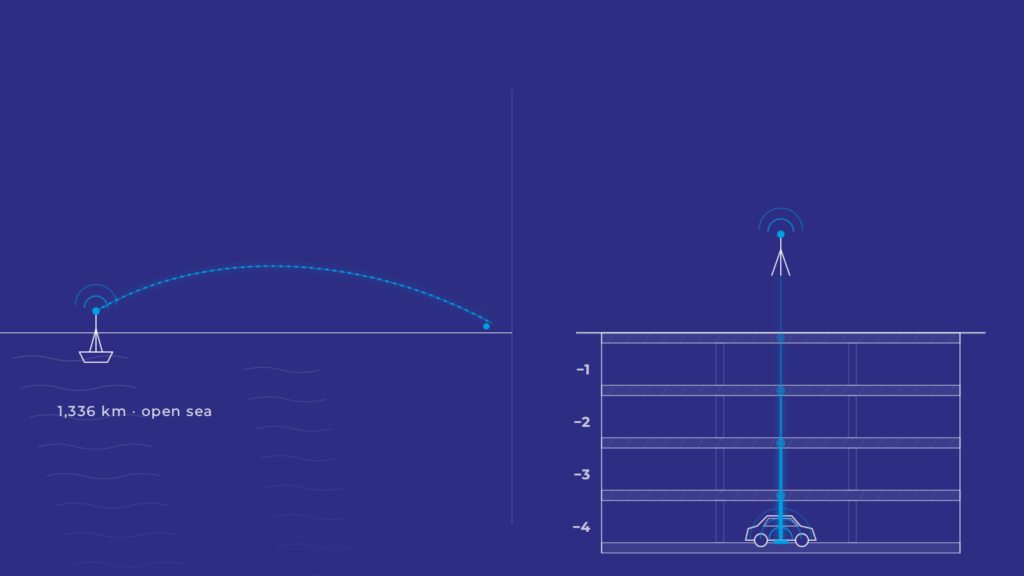
Table of content
What LoRaWAN parking is
LoRaWAN parking means a sensor in each bay reports free or occupied over a LoRaWAN network to gateways you install and own, which pass the data back to your platform. The appeal is real: long range in open air, very low power, a private network with no per-device cellular fee, and full control of your own infrastructure. That model suits some parking sites better than almost any other technology. It also has clear limits, and both come from the same physics.
When LoRaWAN parking is the right choice
LoRaWAN parking is at its best on large, open sites that you control. Think corporate campuses, logistics yards, park-and-ride lots, resorts and surface car parks spread across open ground. If you own the land, want to own the network end to end, and have line of sight for a few rooftop gateways, LoRa’s long open-air range turns into very few gateways covering a lot of bays, with no monthly fee per sensor.
Just how far LoRa can travel in open air became clear in 2023, when a LoRaWAN signal crossed 1336 kilometers over open sea, from trackers off the Portuguese coast to a gateway in the Canary Islands. It is a beautiful piece of engineering and a genuine demonstration of the technology’s reach.
Where LoRaWAN parking meets its limit
That record quietly makes the point for us. It was set at sea level, clear line of sight, no obstacles. The Things Network, which logged it, adds the honest footnote itself: most devices on its network sit between 25 and 100 meters from their gateway. Open-air range is the ceiling in perfect conditions, not the number you design a garage around.
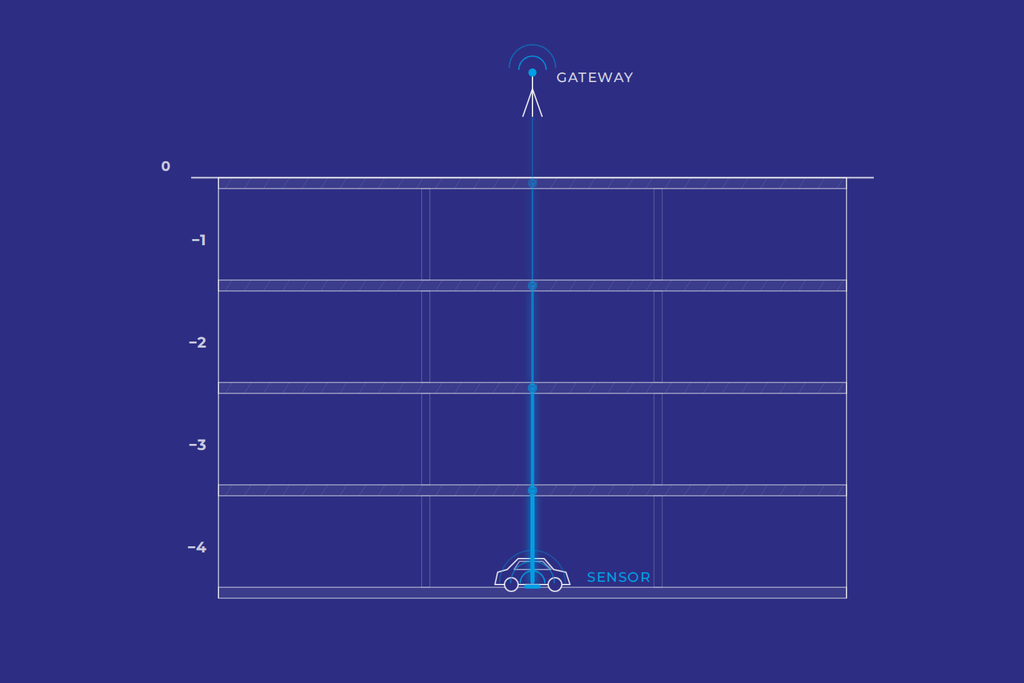
Parking is rarely an open-air problem. A sensor usually sits in a steel-reinforced bay, often several floors underground, surrounded by concrete, parked cars and competing radios. The question is not how far the signal travels. It is whether a status change can get out of level minus four, every time, for years, with nobody on site. That is a penetration problem, and it is where LoRaWAN parking on a deep underground structure starts to need more gateways and more planning than its open-air reputation suggests.
LoRaWAN parking vs NB-IoT and LTE-M
When we specify connectivity, three numbers decide it, and range leads none of them.
Penetration
Can the signal leave the structure? Underground and inside dense buildings, cellular IoT built for deep indoor coverage often gets out where an on-site gateway struggles to hear.
Reliability
A sensor is only as good as the share of events that arrive. If a bay turns over twenty times a day, all twenty messages need to land.
Total cost of the link
Open-air range sounds like fewer gateways. Underground and across a city, the gateway count, the backhaul and the maintenance are the real bill, and a network that needs no gateway on site removes that line entirely.
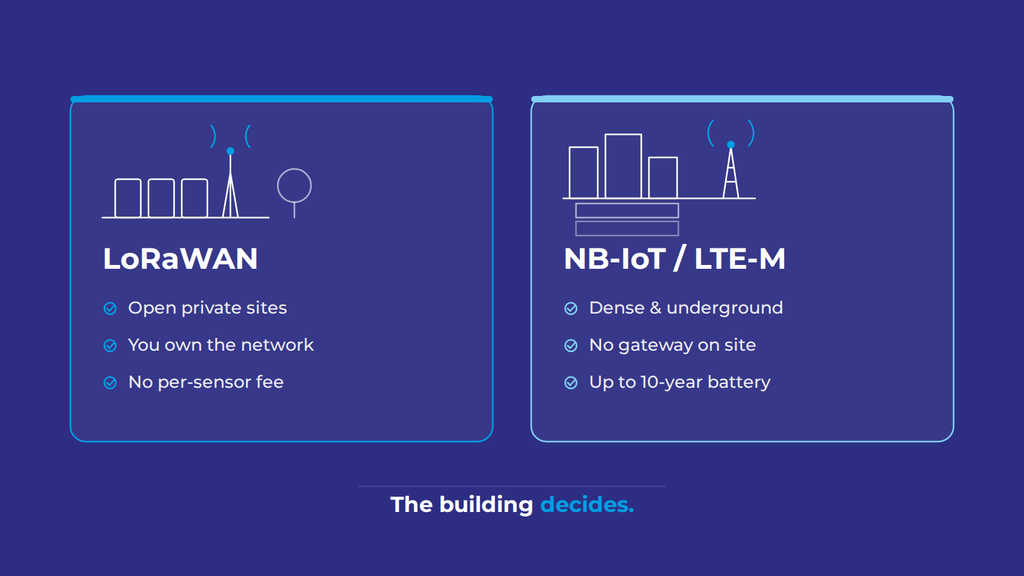
This is why, for most parking, we default to cellular IoT, meaning NB-IoT and LTE-M. These networks already exist in most countries, so there is nothing to install at a client site. They were built for underground and deep indoor penetration. And they let a single sensor run for up to ten years on one battery while reporting reliably from floors below street level.
How to choose for your site
A simple rule. If you control a wide, open site and want to own the whole network, LoRaWAN parking earns its place, and we build LoRa sensors for exactly those cases. If you need every bay in a dense or underground structure to report with no infrastructure on site, cellular usually wins. The building decides, not the brochure, and not the distance record.
The 1336 kilometer record is worth admiring for what it is. It simply answers a different question than the one a parking operator asks, which is quieter and harder: will every bay, on every floor, report every change, for years, without a technician on site. That is the number we design for. Across more than 71,000 parking sensors in over 50 countries, our detection runs at 99.96 percent accuracy, chosen to get out of the building rather than to travel the farthest.
Pick the radio for the concrete you actually have.
Frequently asked questions
Does LoRaWAN work for underground parking?
It can, but it needs gateways that can hear the sensors, usually installed inside or close to the structure, because concrete and depth weaken the signal. Where the owner does not want to install and maintain gateways on site, cellular IoT such as NB-IoT or LTE-M is usually the more reliable choice for underground bays.
NB-IoT vs LoRaWAN: which is better for parking?
Neither in the abstract. LoRaWAN suits wide, open private sites where you want to own the network and avoid per-device fees. NB-IoT and LTE-M suit dense or underground structures where every bay must report reliably with no gateway on site.
What is the LoRaWAN distance record?
In 2023, a LoRaWAN signal traveled 1336 kilometers from trackers on a fishing boat off Sesimbra, Portugal, to a gateway in the Canary Islands, beating the previous record of 832 kilometers. It was set at sea level with a clear line of sight over open water.
