by Mia Ilavska
October 17, 2024
Parking Sensor Accuracy: How We Verified 99.96% Detection

Table of content
Why parking sensor accuracy is the whole game
A parking system is only as trustworthy as its worst readings. For example, if a sensor reports a free space that is actually taken, a driver is sent to a dead end. And if it reports an occupied space that is actually free, the city loses a paying customer. Multiply either error across thousands of spaces, and confidence collapses. Therefore the goal is not "good enough" detection. It is detection you can rely on for every event, in every condition.
How we measure parking sensor accuracy: the ViCheP method
To measure real accuracy, you have to compare what the sensor said with what actually happened. So Fleximodo built ViCheP (Video Check Portal), a custom web app that lines up sensor data against recorded video of the same spaces. The team then reviews the footage and logs every real arrival and departure by hand.

"ViCheP wasn't just about collecting data," says Jozef Vindis, the mechanical engineer who developed the software. "It let us overlay each sensor's location onto the video feed, so the team could see exactly where every sensor sat relative to the vehicles. That made it far easier to spot when an error happened, and why."
The review itself is deliberately manual. The team goes through each 12-hour video segment and records every parking event they see, logging the exact time a vehicle enters or leaves each space. This hand-logged record becomes the baseline, the ground truth of what actually happened. Then we download the data straight from the sensors and compare it against those logged events. By finding the discrepancies, we can isolate the exact scenarios where a sensor diverged from reality and work out why.
Because a human confirms each event, the comparison is exact. Every sensor reading is scored against ground truth: correct detection, missed event, or false trigger. In other words, the accuracy figure is not modelled or estimated. It is counted, event by event, from real parking behaviour.
The challenges we had to solve
Real car parks are messy, and the visual overlay in ViCheP surfaced the exact situations that tripped up early detection. Two came up again and again:
- Quick transient events. A car briefly enters a space without really parking, for example while turning around, or one vehicle leaves and another arrives within seconds. The sensor has to tell a real event apart from a moment of noise.
- Extended adjustment periods. A driver takes time shuffling back and forth to line up in the bay. That drawn-out movement made it harder for the sensor to decide when the parking event was actually final.
In each case, the team traced the root cause and refined how the sensor decides when an event begins and ends, rather than just tuning a single threshold. That is the work that turns a good sensor into a reliable one.lone.
Why magnetometer plus radar lifts parking sensor accuracy
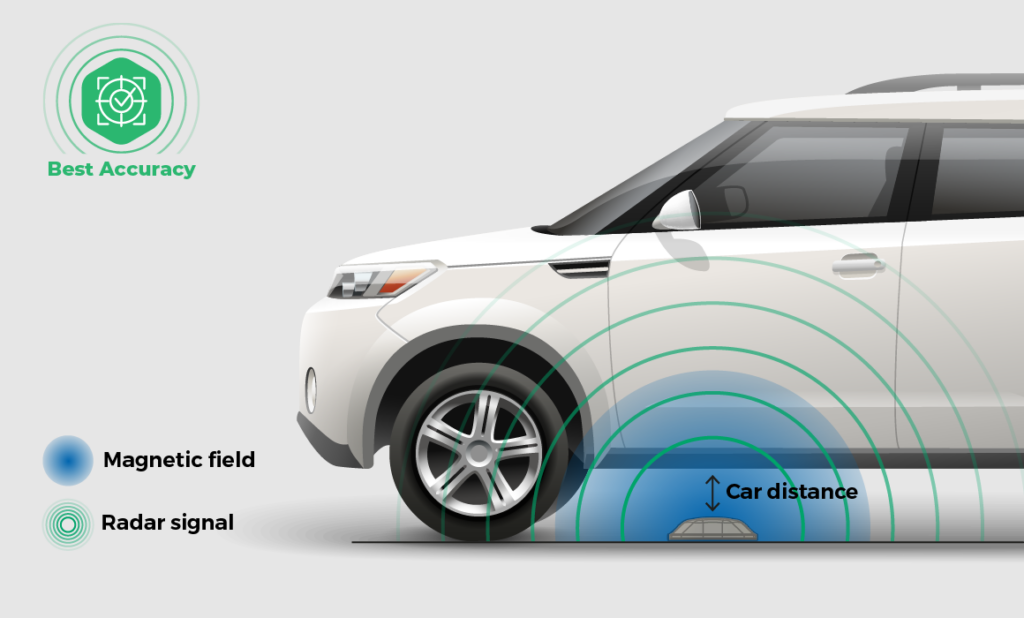
A magnetometer on its own reaches around 95% accuracy. That sounds high, but it means one reading in twenty could be wrong, which is not good enough at city scale. So Fleximodo added a nano-radar component. The magnetometer detects the change a vehicle makes in the magnetic field, and the radar confirms it by sensing the object directly above the sensor.
Because two independent methods have to agree, the edge cases that fool one method are caught by the other. As a result, verified accuracy rises from about 95% to 99.96%. For the full detection mechanism, see how parking sensors work.
What 99.96% actually means for a deployment
At 99.96%, errors become rare enough that operators, drivers, and enforcement teams can trust the data without second-guessing it. So guidance signs stay right, enforcement stays fair, and the occupancy reports that cities use for planning hold up. This is the accuracy behind results like the Pardubice deployment and every number in our digital parking management system.
Reaching this level of accuracy changed the conversation we have with cities," says Bohdan Jacos, who leads Sales department at Fleximodo. "Operators do not want promises, they want proof. Once we can show a verified 99.96%, the question stops being whether the sensors work, and becomes how quickly we can roll them out across the site."
FAQ
How accurate are parking sensors?
The most accurate IoT parking sensors reach around 99.96% detection accuracy when they combine two methods, a magnetometer and a radar. A magnetometer alone typically reaches about 95%. Fleximodo verified 99.96% by comparing sensor data against recorded video, event by event..
How is parking sensor accuracy measured?
Fleximodo measures it with ViCheP, a video-check portal that aligns sensor readings with recorded video of the same spaces. A person logs every real arrival and departure, so each reading is scored against ground truth rather than estimated.
Why combine a magnetometer and radar?
A magnetometer alone can be fooled by large metal objects, high-clearance vehicles, or difficult surfaces. Adding radar confirmation means two independent methods must agree, which catches those edge cases and lifts accuracy from about 95% to 99.96%.
What is the most accurate parking sensor?
The most accurate parking sensor pairs two detection methods, a magnetometer and a radar. That dual design reaches a verified 99.96%, versus about 95% for a magnetometer-only sensor.
Why combine a magnetometer and radar?
A magnetometer alone can be fooled by large metal objects, high-clearance vehicles, or difficult surfaces. Adding radar confirmation means two independent methods must agree, which catches those edge cases and lifts accuracy from about 95% to 99.96%.
