by Mia Ilavska
July 13, 2026
Digital Parking Management System: How It Actually Works
A digital parking management system uses IoT sensors and cloud software to show every parking space in real time. Here is how the sensors, networks, and dashboard work together, and the results cities like Pardubice have already seen.
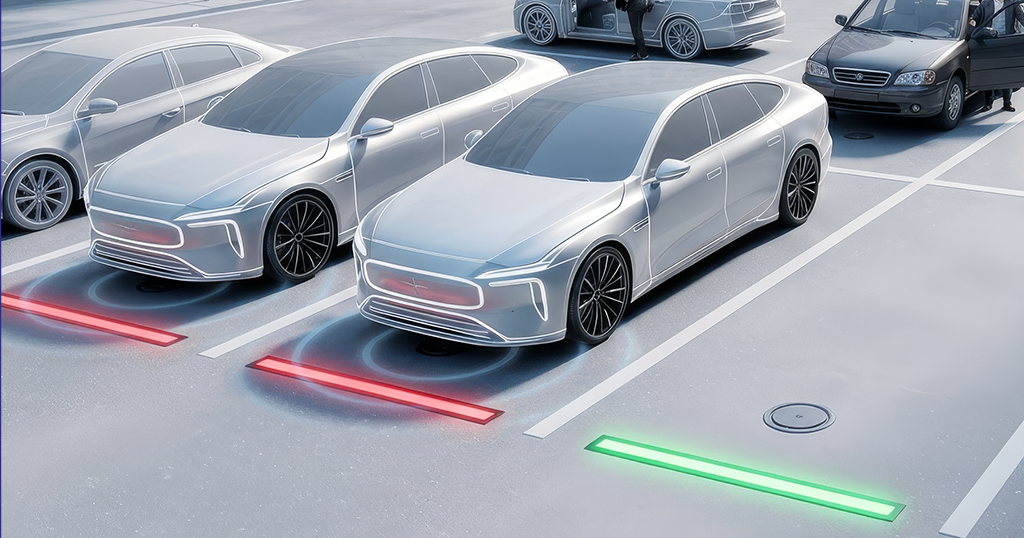
Table of content
What is a digital parking management system?
A digital parking management system is the combination of hardware and software that digitalizes how a parking area is monitored, guided, and managed. It has three layers: sensors that detect occupancy, a network that carries the data, and cloud software that makes it useful. Some people call it a smart parking system and others call it a parking management system. The terms describe the same thing from different angles. "Smart parking" leans on the driver experience. "Parking management system" leans on the operator running the site.
The four core components
IoT occupancy sensors.
One sensor sits at each space, either under the surface or on top of it. Fleximodo sensors detect a vehicle through the change it makes in the local magnetic field, then confirm that reading with a radar pulse. Two independent methods in one device is why detection reaches 99.96% accuracy instead of the 95% typical of magnetometer-only sensors. Each sensor runs up to 10 years on a single battery, so there is no cabling and no trenching across a car park. For a closer look at the detection method, see how Fleximodo parking sensors work.
Wireless connectivity.
Sensors report over low-power networks built for exactly this kind of small, frequent message: NB-IoT, LoRa, Sigfox, and LTE-M. The right choice depends on the site. NB-IoT and LTE-M use existing mobile coverage and suit dense cities. LoRa suits large private sites where you run your own gateway. The sensor sends a status change, not a video stream, so power draw stays tiny and one battery lasts years.
Cloud software platform.
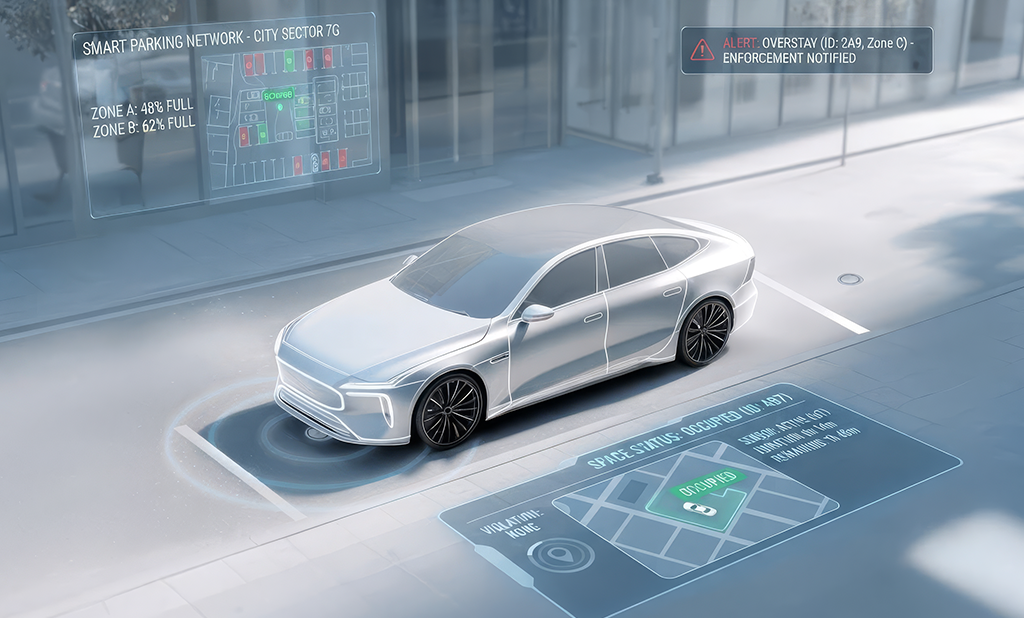
This is where raw occupancy becomes management. A cloud-based parking management system aggregates every space in real time, shows live maps, stores history for analysis, handles digital permits and payments, and exposes an API so the data flows into a city portal, a mobile app, or a third-party system. Because it is cloud based, an operator checks a site from any device with no on-site server to maintain.
Driver-facing guidance.
The last layer points drivers to a free space before they start circling: mobile apps, LED or flip-dot signs at the entrance and at each aisle, and digital permit cards for residents and staff. Guidance is where the occupancy data pays back in less traffic and lower emissions.
How it works, step by step
- A car pulls into a space. The sensor registers the magnetic field change and confirms it with radar.
- The sensor sends the new status over NB-IoT, LoRa, Sigfox, or LTE-M.
- The cloud platform updates that space and recalculates availability for the whole site.
- The new count is pushed to signs, apps, and the operator dashboard within seconds.
- Operators use the same data for enforcement, dynamic pricing, and long-term planning.
The loop runs every time a vehicle moves. No survey, no manual count, no delay.
Sensors, cameras, indoor, outdoor
Two detection methods dominate the market: in-ground sensors and cameras. Sensors give one reading per space and keep working in rain, snow, glare, and darkness, which makes them reliable on-street and in open lots. Cameras can watch several spaces at once and read plates, which suits some enclosed structures. Many sites mix both. The deciding factors are lighting, layout, and how much you value per-space certainty over wide-area coverage. For a full breakdown, see our guide to parking sensors vs cameras
What results does it deliver
The point of the system is not the technology. It is what the technology changes.
Take Pardubice, in the Czech Republic. There, a citywide deployment of 3,421 sensors lifted parking revenue from CZK 23 million to CZK 40 million in three years. It also pushed compliance above 90%. In Abu Dhabi, meanwhile, 1,750 sensors brought order to patient, visitor, and staff parking at Sheikh Shakhbout Medical City, across a site of more than 400,000 square metres. And across all deployments, better use of existing spaces cuts search traffic by up to 30%, while saving roughly 7 tonnes of CO2 per digitalized space each year. Demand is climbing worldwide too, as the smart parking market analysis by Mordor Intelligence shows
That last number is the paradox worth sitting with. The fastest way to fix parking is rarely to build more of it. It is to use what already exists, and to see it clearly.
How to choose a digital parking management system
If you are comparing vendors, weigh these six things:
- Accuracy. Ask for a verified figure and the method behind it, not a marketing number.
- Battery life. Ten years means install once. Shorter life means recurring truck rolls.
- Network options. More supported networks means the system fits the site, not the other way around.
- Open software. An API and clean integrations matter more than a closed dashboard.
- Scalability. The same system should run 50 spaces or 5,000.
- Delivery and support. Lead time and after-sales support decide whether a pilot becomes a rollout.
How does smart parking work?
Smart parking works by placing an IoT sensor at each space that detects whether a car is present, sending that status wirelessly to a cloud platform, which then shows live availability to drivers through apps and signs and to operators through a dashboard.
How do parking sensors work?
Fleximodo parking sensors detect a vehicle through the change it causes in the magnetic field above the sensor, confirmed by a radar pulse for certainty. The two methods together reach 99.96% detection accuracy, and each sensor runs up to 10 years on one battery.
What is the difference between a digital parking management system and a smart parking system?
They describe the same setup. "Digital parking management system" emphasizes the operator's management and dashboard side. "Smart parking" emphasizes the driver's experience of finding a space.
Is a digital parking management system cloud-based?
Yes. The platform is cloud based, so occupancy data, analytics, permits, and integrations are available in real time from any device, with no on-site server to maintain.
How much does a digital parking management system cost?
Cost depends on the number of spaces, the sensors and signage chosen, and the software plan. Because sensors are battery powered and wireless, there is no trenching or cabling, which keeps installation cost far below wired systems. Ask for pricing per space at your site size.
