by Mia Ilavska
July 24, 2026
Traffic Congestion Solutions: How Smart Parking Cuts Cars and Emissions
Up to 30% of urban traffic is not going anywhere. It is circling for parking. This is how smart parking works as a traffic congestion solution, cutting cruising, emissions, and the pressure to build more.
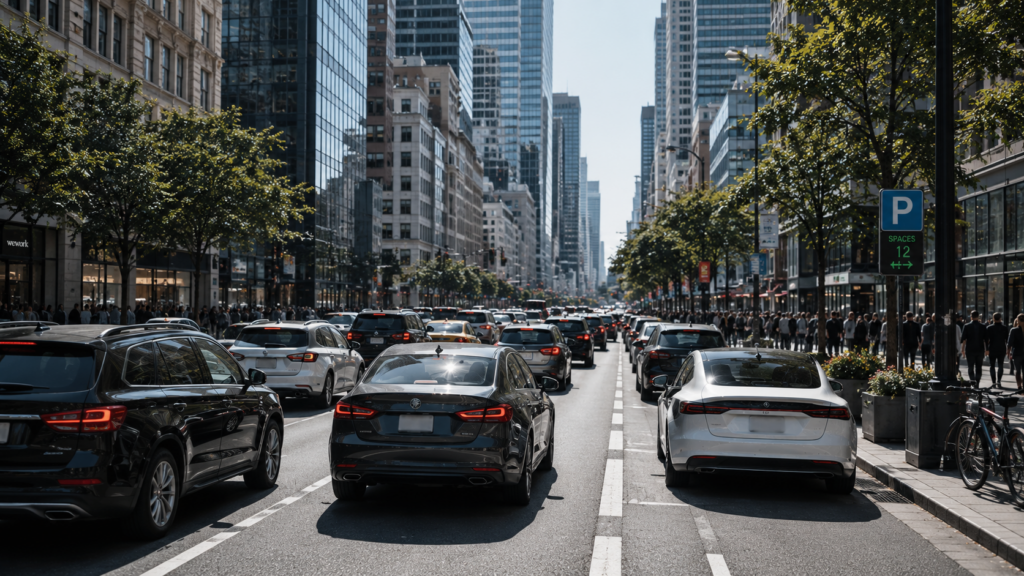
Table of content
What actually causes urban congestion
Congestion is not only about too many cars entering a city. A big part of it is created inside the city, by drivers already there looking for a space. Because searching is slow and blind, one driver can crawl for several minutes past full bays, blocking the lane behind them. Multiply that by thousands of drivers a day, and cruising becomes a permanent layer of traffic on top of normal demand.
As a result, the fix is information. When drivers know where the free spaces are before they arrive, they stop circling.
How smart parking reduces traffic congestion
Smart parking attacks congestion directly. First, an IoT sensor at each space detects whether it is free or taken. Then a platform counts availability in real time and pushes it to apps and guidance signs. So drivers head straight to an open bay instead of crawling the block.
The effect is measurable. Real-time guidance can cut search traffic by up to 30%, which means fewer cars in the lane, shorter queues, and less idling at junctions. To see the full system behind this, read our guide to the digital parking management system.
The emissions math
Less cruising means less fuel burned for nothing. The numbers add up quickly.
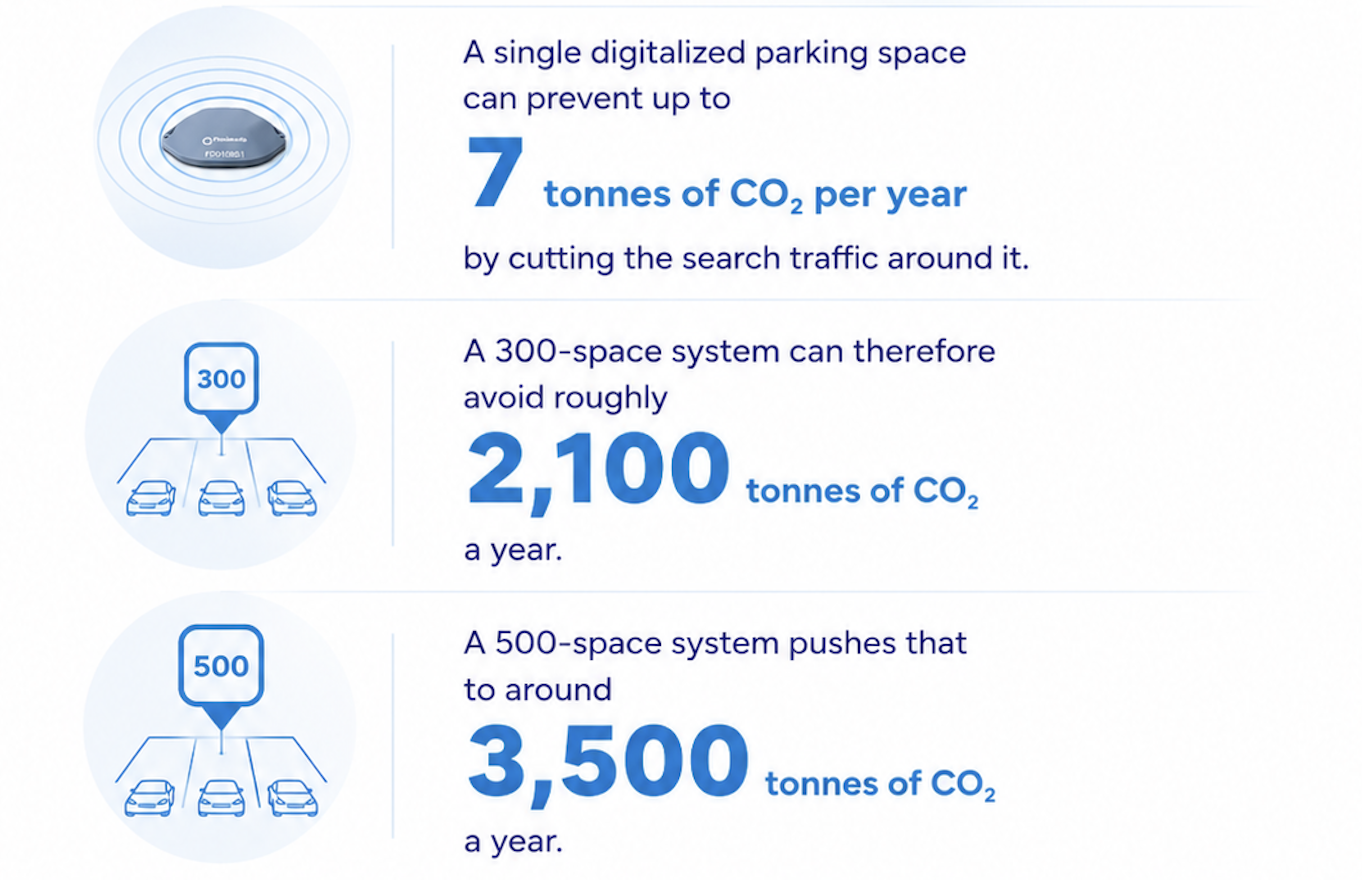
- A single digitalized parking space can prevent up to 7 tonnes of CO2 per year by cutting the search traffic around it.
- A 300-space system can therefore avoid roughly 2,100 tonnes of CO2 a year.
- A 500-space system pushes that to around 3,500 tonnes a year.
In other words, sustainability here is not a slogan. It is a direct output of making parking visible, and it scales with the size of the deployment.
Idling: the hidden polluter
Cruising has a quieter cousin: idling. An engine running while a car waits or searches burns fuel and emits CO2 for zero distance travelled. The scale is large: in the UK alone, winter idling has been estimated at over 100,000 tonnes of CO2 a year. Because sensors cut both search time and standstill queuing, they attack idling too. We cover this in depth in Beating the Idle.
Low-emission zones, dynamic pricing, and ESG
Smart parking data also powers the policy tools cities use to clean their air. For example, occupancy and flow data help enforce low emission zones and support demand-based pricing, so the busiest areas price to keep traffic moving. For property owners and operators, the same data feeds ESG reporting with real, measured numbers rather than estimates. Europe’s growing network of access regulations makes this kind of measured, data-backed compliance increasingly valuable.
The Parking Paradox
Here is the part worth keeping. A company that sells parking technology is telling you that the answer is rarely more parking. Because the real waste is not a shortage of spaces. It is spaces nobody can find, and cars burning fuel to look for them. Fix the visibility, and a city cuts congestion, emissions, and cost at the same time, without pouring a single new slab of concrete. See how this plays out for whole cities on our municipal parking page, and in the Pardubice case study.
FAQ
How does smart parking reduce traffic congestion?
Smart parking uses IoT sensors to show drivers where free spaces are in real time, so they drive straight to an open bay instead of circling. Because up to 30% of city traffic is drivers searching for parking, removing that search traffic cuts congestion at its source.
How much CO2 can smart parking save?
A single digitalized parking space can prevent up to 7 tonnes of CO2 per year by cutting search traffic. A 300-space system can avoid roughly 2,100 tonnes a year, and a 500-space system around 3,500 tonnes.
Is smart parking really a sustainability tool?
Yes. By cutting cruising and idling, it directly reduces fuel use and emissions, and it supplies measured data for low-emission zones, dynamic pricing, and ESG reporting.
Does reducing parking search really cut traffic?
Yes. In busy centers, up to 30% of traffic is cruising for parking. Real-time guidance removes much of that, which means fewer cars in the lane and less idling at junctions.
What is the Parking Paradox?
It is the idea that most cities do not need more parking or more road. They need to use existing spaces efficiently. Better data, not more concrete, is usually the faster and greener fix.
