by Mia Ilavska
February 3, 2025
Parking Sensors vs Cameras: Which Is the Smarter Choice?
Parking sensors vs cameras: which detection technology is right for your site? Compare accuracy, coverage, cost, and reliability across on-street, open lots, and enclosed garages, and see why many sites use both.
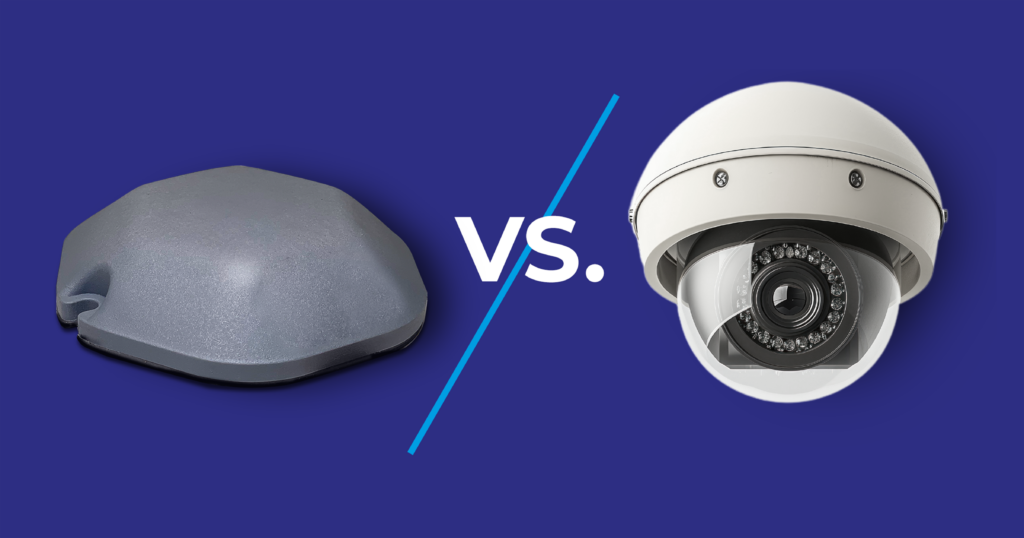
Table of content
How each one detects a car
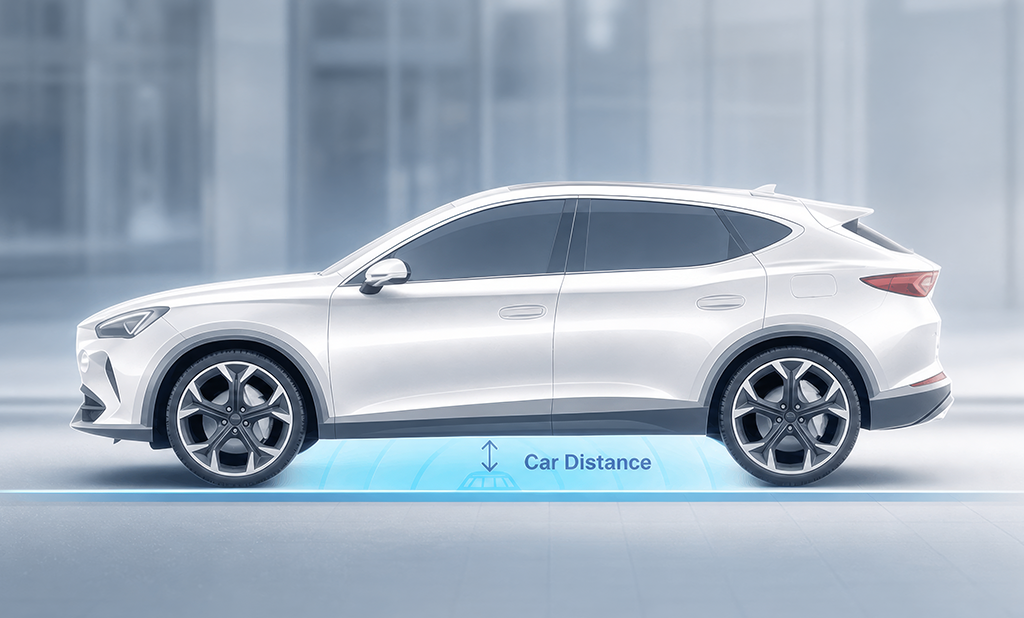
An in-ground sensor sits at a single space and detects the vehicle directly, through the change it makes in the local magnetic field, confirmed by a radar pulse. It reports over a low-power network such as LoRaWAN, so it runs for years on one battery. As a result, one space gives one certain reading, regardless of light.
A camera, by contrast, sits above and watches many spaces at once, using computer vision to decide which are occupied. So one device gives wide coverage. However, the reading depends on what the lens can see.
The comparison that matters
| IoT parking sensors | Cameras | |
| Reading per space | One direct reading per bay | Inferred from an image of many bays |
| Coverage per device | One space (some cover two) | Up to ~20 bays indoors, more outdoors with clear sight lines |
| Light and weather | Works in glare, darkness, rain, snow | Sun glare and reflective cars cause false readings |
| Power and cabling | Battery powered, up to 10 years, no trenching | Needs power and often network cabling |
| Failure mode | One sensor down affects one space | One camera down affects every space it watched |
| Extra data | Occupancy, plus idling detection | Plate recognition, unusual-behaviour detection |
| Best fit | On-street, open lots, per-space certainty | Enclosed structures, wide-area, plate use cases |
Where cameras struggle
Cameras fight physics outdoors. For example, a white car in bright sun reflects enough light to blind the lens, which produces false readings exactly when a site is busiest. In addition, curved ramps, pillars, and complex geometry create blind spots that no single mounting point can solve. And because one camera covers many spaces, a single failure takes all of those spaces offline at once.
Where sensors struggle
Still, sensors are not free of trade-offs. Because you install one per space, a very large enclosed garage means more devices than a handful of cameras would need. And if your main goal is plate recognition or watching for theft across a wide area, a camera does that in one device, whereas a sensor does not.
How to choose for your site
So here is how the choice usually breaks down by site type.
- On-street parking: sensors. Light, weather, and per-space certainty rule out cameras.
- Open surface lots: sensors, or cameras only where sight lines are genuinely clear.
- Enclosed multi-storey garages: either, often both. Cameras for wide aisles and entry plate reading, sensors where certainty per bay matters.
- Sites with no mains power: sensors. Battery life of up to 10 years removes the cabling problem entirely.
- Sites that need enforcement by plate: cameras, ideally alongside sensors for occupancy.
In short, the parking sensors vs cameras decision is about matching the technology to the space, not picking a side. For example, a distributed system of sensors removes single points of failure and keeps working in bad light. Meanwhile, a camera earns its place where one device must cover a wide, well-lit, enclosed area.
Are parking sensors better than cameras?
For on-street and open outdoor parking, sensors are more reliable because they give one direct reading per space and are not affected by glare, darkness, or weather. Cameras can be a better fit inside enclosed structures where one device needs to cover many spaces or read number plates.
How accurate are IoT parking sensors compared to cameras?
Fleximodo sensors reach 99.96% detection accuracy by combining a magnetometer with a radar confirmation. Camera accuracy depends heavily on lighting and sight lines and drops in glare or with reflective vehicles.
Can you use parking sensors and cameras together?
Yes, and many large sites do. Sensors handle per-space certainty on-street and in open lots, while cameras cover wide enclosed areas and plate recognition. The two complement each other.
Do parking sensors need power and cabling?
No. IoT parking sensors are battery powered, with a life of up to 10 years, and communicate wirelessly, so there is no trenching or cabling across the site. Cameras generally need both power and network connections.