by Mia Ilavska
September 25, 2026
EV Charging and Smart Parking: How They Fit Together
An EV charging bay only works if an EV can actually park in it. Smart parking keeps charging bays free of blockers and turning over. Here is how sensors and EV charging fit together.
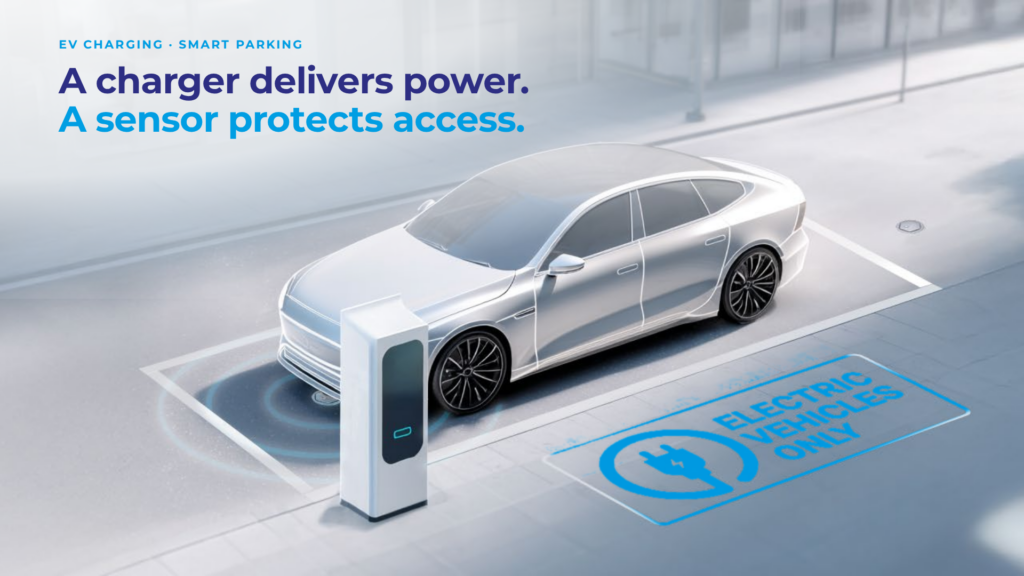
Table of content
The problem: chargers blocked and hogged
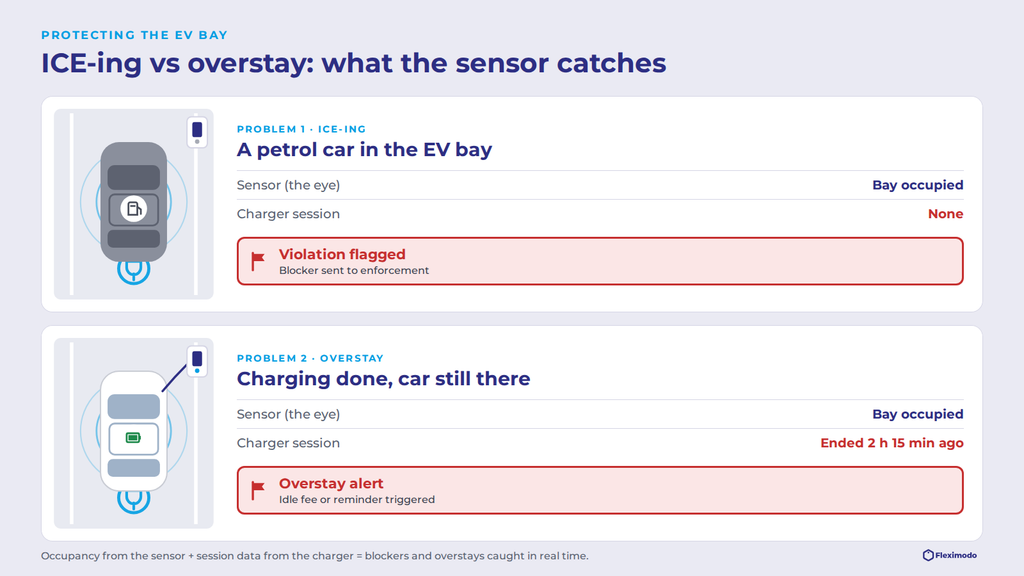
EV charging bays fail for two reasons, and neither is the charger’s fault. The first is ICE-ing: a petrol or diesel car parks in the charging bay and blocks it entirely. The second is overstaying: an EV finishes charging but sits in the bay for hours, so no one else can use it. Both waste an expensive asset, and both are invisible without occupancy data. A charger reports energy delivered, not whether the bay is being misused.
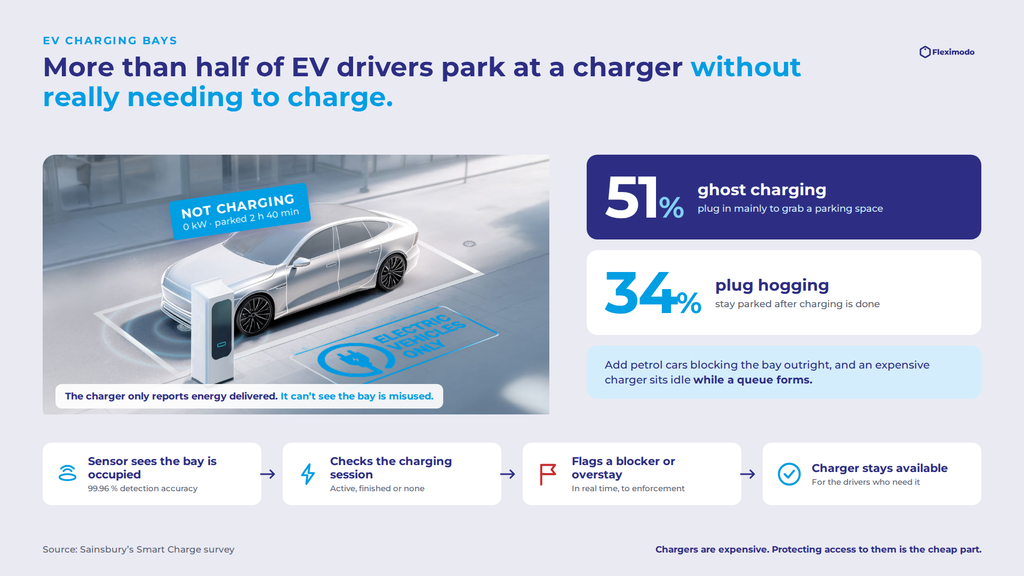
The problem is common enough to have names and numbers. ICE-ing has its own term because it happens so often. And it is not only petrol cars at fault: a survey by Sainsbury’s Smart Charge found that 51 percent of EV drivers admit to “ghost charging”: plugging in mainly to claim a parking space rather than to charge. That blocks the bay just the same. In the same survey, 34 percent named “plug hogging” (staying parked after charging ends) as a top frustration. Either way, an expensive charger sits idle while a queue forms.
How smart parking for EV charging protects the bay
A parking sensor gives the charging bay eyes. It detects when the bay is occupied and, paired with a permit or the charger’s own session data, whether the occupant is a charging EV or a blocker. An ICE car in the bay is flagged as a violation. An EV that lingers long after its session ended can trigger an overstay alert or an idle fee. Fleximodo sensors detect at 99.96 percent accuracy, so these alerts are reliable enough to act on.
The turnover at stake is real. In our own data, a monitored bay changes occupant about six times a day, so an EV left in a charging bay for hours after its session removes several of those uses from other drivers. That lost turnover is exactly what an idle fee is designed to protect.
That turns a passive charging bay into a managed one, where access is protected and turnover is enforced. See parking violation detection for how the enforcement side works.
Guidance and planning
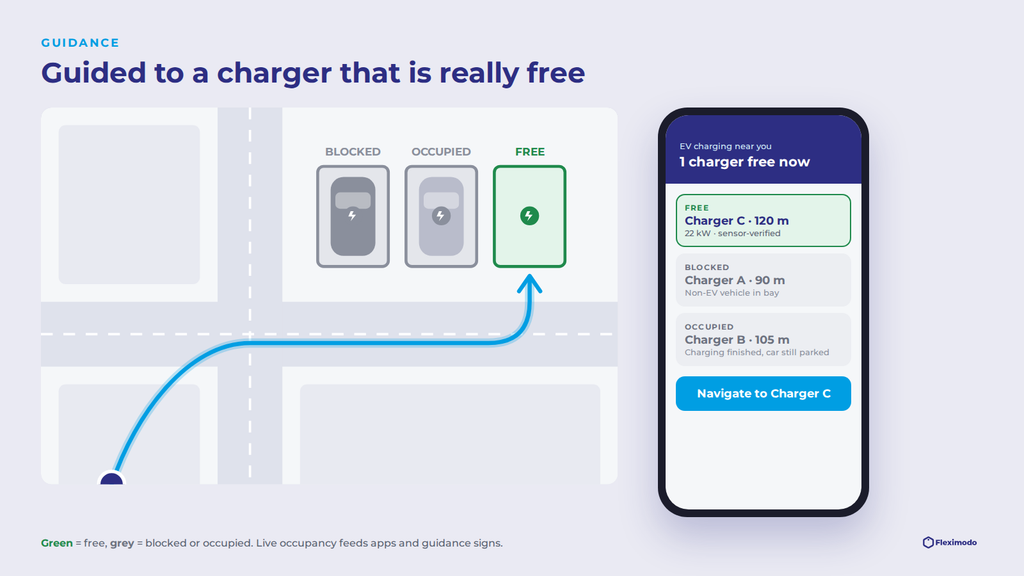
With smart parking for EV charging, occupancy data also helps drivers find a working, free charger instead of driving to a blocked one. Live availability can feed apps and parking guidance signage, so an EV driver is routed to an open bay. And over time, the same data shows which chargers are oversubscribed and where new ones are actually needed, so a city expands charging based on demand rather than guesswork.
FAQ
How does smart parking support EV charging?
Smart parking adds a sensor to each EV charging bay that detects occupancy and, with permit or session data, whether the occupant is a charging EV. It flags blockers and overstays in real time, guides drivers to free chargers, and shows where new chargers are actually needed.
What is ICE-ing and how do sensors stop it?
ICE-ing is when a petrol or diesel car parks in an EV charging bay and blocks it. A sensor detects the bay is occupied while the charger reports no active session, which flags the vehicle as a blocker so enforcement can act, protecting the bay for EV drivers.
Can sensors stop EVs overstaying after charging?
Yes. By combining occupancy data with the charging session, the system knows when a vehicle remains in the bay after charging has finished. It can trigger an overstay alert or an idle fee, which encourages turnover so more drivers can use the charger.
Do EV charging sensors need cabling?
No. Fleximodo sensors are battery powered and wireless, running up to 10 years with no cabling or civil works. They install in 10 to 15 minutes, so charging bays can be monitored without disrupting the electrical installation.
How do drivers find an available EV charger?
Live occupancy from the sensors can feed apps and guidance signage, so an EV driver is routed to a charging bay that is genuinely free rather than one that is blocked or occupied. This cuts the time spent searching for a working charger.
