by Mia Ilavska
July 29, 2026
Parking Minimums Are Inflating Housing Costs. Here Is the Cheaper Fix.
Parking minimums force developers to build spaces nobody measured demand for, and the cost lands in everyone's rent. Here is what the research says, why 3,700+ cities are reforming, and how to add capacity without pouring concrete.
Table of content
What are parking minimums?
Parking minimums, also called minimum parking requirements or parking mandates, are zoning rules that set how many parking spaces a new building must include. They date to the mid-20th century, when planners assumed every household would own a car. A 2018 survey found 53 percent of European countries still enforce some form of car-parking minimum. Because the rule is written as spaces-per-unit rather than measured demand, it forces developers to build capacity that a growing share of urban households, especially the rising number of single-person households, simply do not use.
How much a mandated parking space really costs
“Parking is one of the most expensive things a developer can be required to build per square metre. Surface spaces are cheap, at €3,000 to €5,000, but urban density pushes new builds underground, where costs climb fast.” — Jan Hroncak, Head of Business Development, Fleximodo
- 20,000 to 80,000 euro to build a single underground space in an EU city.
- Underground parking makes up roughly 10 to 20 percent of the construction cost of each housing unit.
- In the US, comparable studies put underground parking at $50,000 to $73,000 per space, so the pattern is structural, not local.
Excavation, dewatering, shoring, ventilation and ramping eat most of that budget before a single car parks.
How that cost ends up in your rent
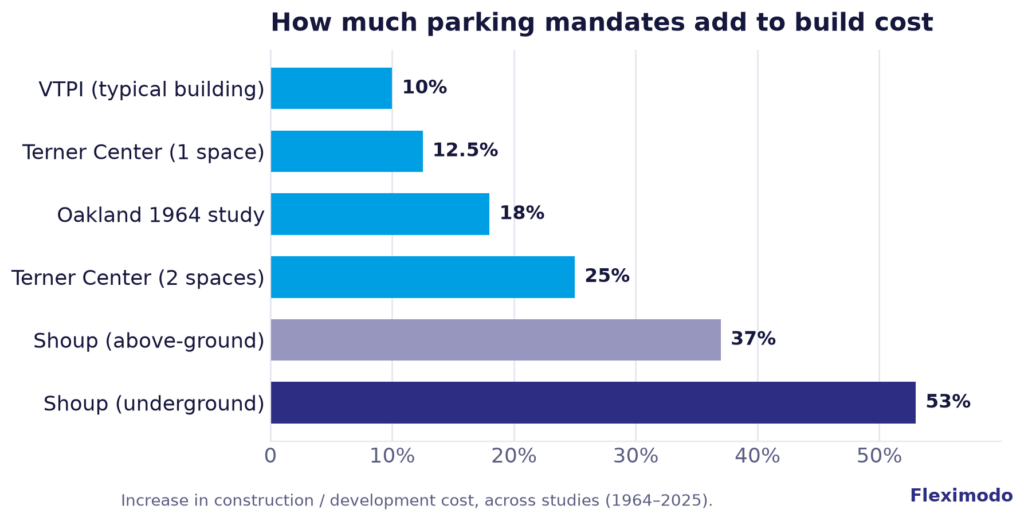
Parking costs do not sit on the developer’s balance sheet. They are baked into land value, financing, and ultimately sale prices and rents. Donald Shoup’s foundational research found that minimum parking requirements raise housing construction costs by an average of 37 percent above ground and 53 percent underground. UC Berkeley’s Terner Center found two mandated spaces can add up to 25 percent to per-unit development cost.
It compounds, because parking eats buildable floor area, so a site yields fewer homes. When Seattle reformed its rules in 2018, developers built 40 percent less parking, avoiding roughly 18,000 spaces and an estimated $537 million in construction cost that could go toward housing instead.
Reform is spreading in 2026
Cities have noticed. As of 2025, more than 3,700 cities across 22 countries had reformed or removed parking minimums, and over 100 removed them entirely. Hamburg abolished minimums for apartment and student housing. Utrecht is building a 6,000-apartment district car-free. And the outcome that worries planners most, a parking shortage, has not materialised: developers keep building parking where real demand exists, they just build less of it, and only where the market calls for it.
The cheaper fix: unlock the spaces you already have
Reform is not the only lever. The other is to make existing parking radically more efficient with real-time data, turning a static asset into a shared one. Most unmanaged lots and campuses run at just 45 to 65 percent of capacity. That under-utilization, not a genuine shortage, is usually the real problem, and it closes with sensors and software instead of excavation.
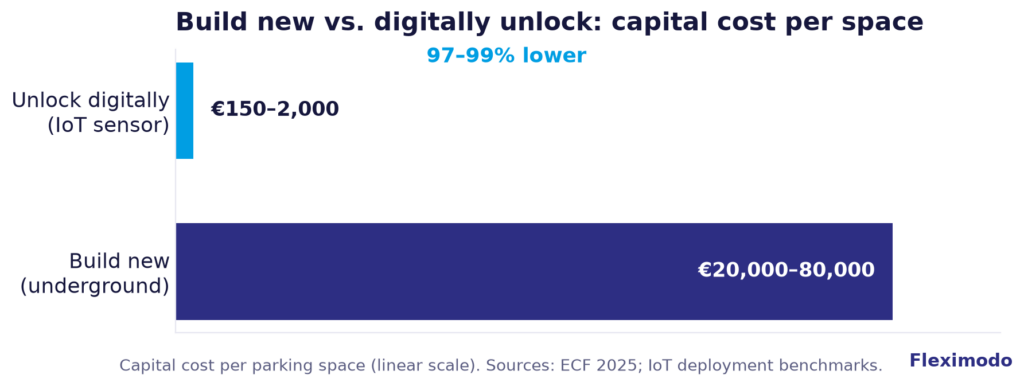
This is where the economics get hard to ignore. Building one new underground space costs 20,000 to 80,000 euro. Digitally unlocking an existing space with an IoT parking sensor and management software runs roughly 150 to 2,000 euro, a capital-cost reduction of 97 to 99 percent. At Henkel’s Bratislava campus, 200 physical spaces were made to serve 600 employees, an effective tripling of capacity with zero new construction. Pardubice digitized 3,815 municipal spaces and grew parking revenue 74 percent with no new build and no tariff increase. See how it works in our guide to the digital parking management system, and how it plays out for cities on our municipal parking page.
The Parking Paradox in one line: the cheapest parking space is the one you already built and finally used properly.
FAQ
What are parking minimums?
Parking minimums, or minimum parking requirements, are zoning rules that force a new building to include a set number of parking spaces per home or per square metre, regardless of measured demand. They originated in the mid-20th century and 53 percent of European countries still enforce some form of them.
Do parking minimums increase housing costs?
Yes. Research spanning six decades finds mandated parking raises building costs by roughly 10 to 40 percent, and up to 53 percent for underground housing parking (Shoup). Because each underground space costs 20,000 to 80,000 euro to build, that cost passes through into purchase prices and rents, even for residents without a car.
How much does a parking space cost to build?
A surface space costs about 3,000 to 5,000 euro, but an underground space in an EU city costs 20,000 to 80,000 euro. US studies put underground parking at roughly $50,000 to $73,000 per space. Excavation, structural work and ventilation drive most of the cost.
Are cities removing parking minimums?
Yes. By 2025 more than 3,700 cities across 22 countries had reformed or removed parking minimums, with over 100 eliminating them entirely, including Hamburg and much of the Netherlands. Cities that reformed did not run out of parking.
What is the alternative to building more parking?
Unlocking existing capacity with real-time occupancy data. Unmanaged lots run at 45 to 65 percent utilization; sensors and software raise that to 85 to 95 percent, adding effective capacity at 97 to 99 percent lower cost than new construction, with no new concrete.
