by Mia Ilavska
October 12, 2026
How We Test Parking Sensor Accuracy: Inside ViCheP
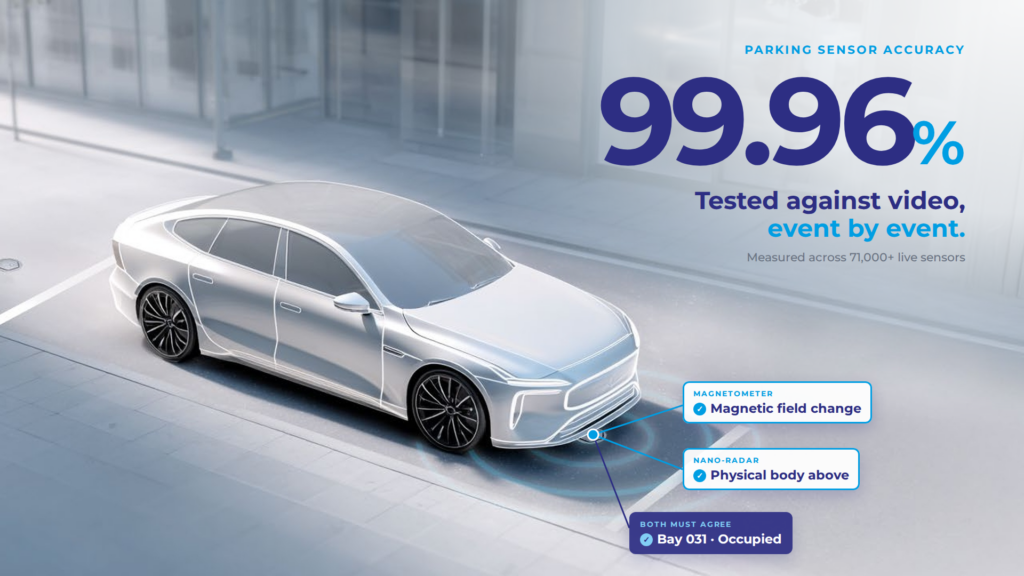
Table of content
Parking sensor accuracy testing with ViCheP
To validate sensor data against reality, we built a web application called ViCheP (Video Check Portal). It lets our team compare real-world parking events with what the sensor reported, visually and precisely.
ViCheP takes video from a car park fitted with test sensors and overlays the parking layout on the footage, marking each sensor position and space boundary. The result is a live map of where every sensor sits relative to the vehicles above it.
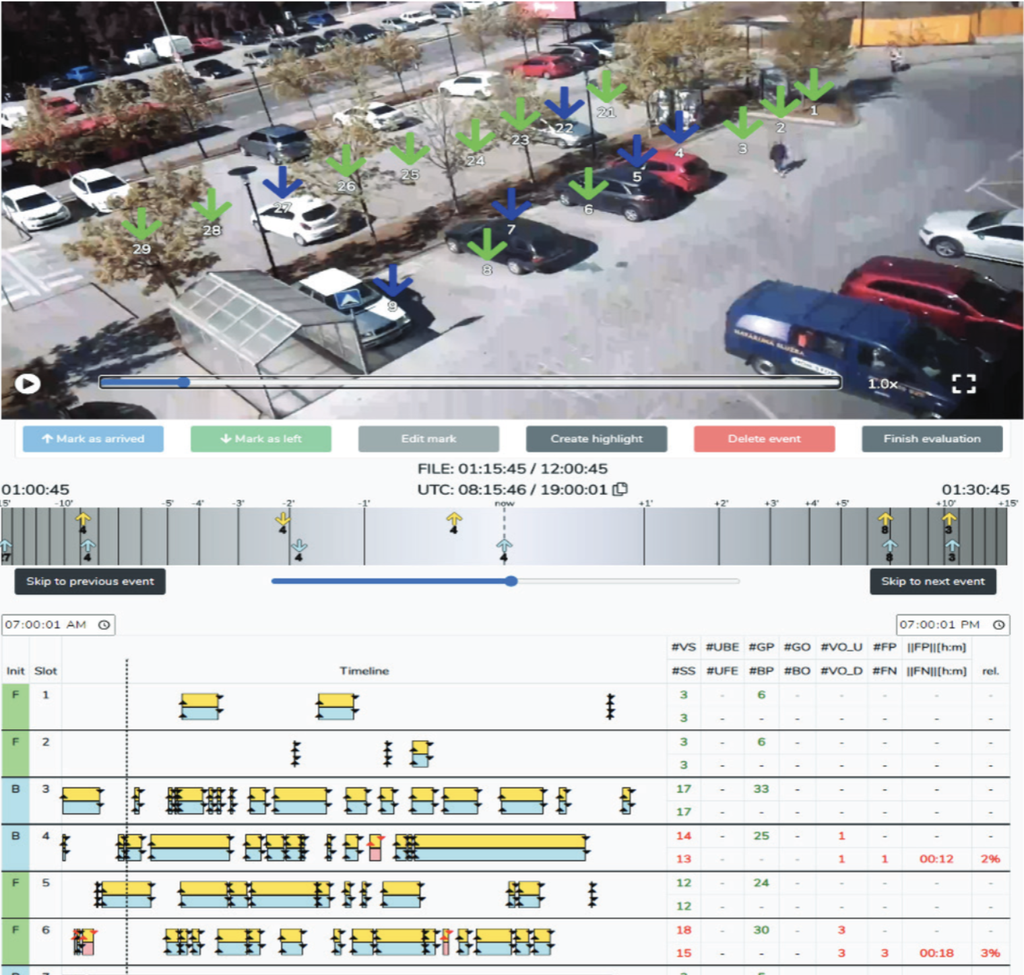
“ViCheP wasn’t just about collecting data,” explains Jozef, the mechanical engineer who built the software. “It let us overlay sensor locations on the video feed, so the team could see exactly where every sensor sat relative to the vehicles. That made it much easier to spot when and why an error happened.”
Parking sensor accuracy testing starts with a manual baseline
The team then reviewed each 12-hour video segment manually, logging every parking event on screen with the exact time a vehicle entered or left each space. That hand-built record was the ground truth.
We then pulled the sensor data and compared it, event by event, against the video log. This side-by-side comparison is the core of our parking sensor accuracy testing. Every discrepancy pointed to a specific scenario we could analyze and trace back to a cause.
What parking sensor accuracy testing revealed
ViCheP surfaced a few situations that tripped early versions:
- Quick transient events. A car briefly entering a space without parking, for example turning around, or one vehicle leaving and another arriving within seconds.
- Extended adjustment periods. A driver shuffling back and forth to straighten up, which made it harder for the sensor to finalize the event.
In each case we found the root cause and adjusted sensor sensitivity and detection parameters, so performance held up under messy, real conditions rather than ideal ones. Each fix then went back through the same parking sensor accuracy testing to confirm it worked.
Two sensors, not one: magnetometer plus nano-radar
Our first sensors used a magnetometer alone, which reached around 95 percent accuracy. A magnetometer reads the change a vehicle makes in the local magnetic field, which is reliable but can be fooled by interference or by the edge cases above.
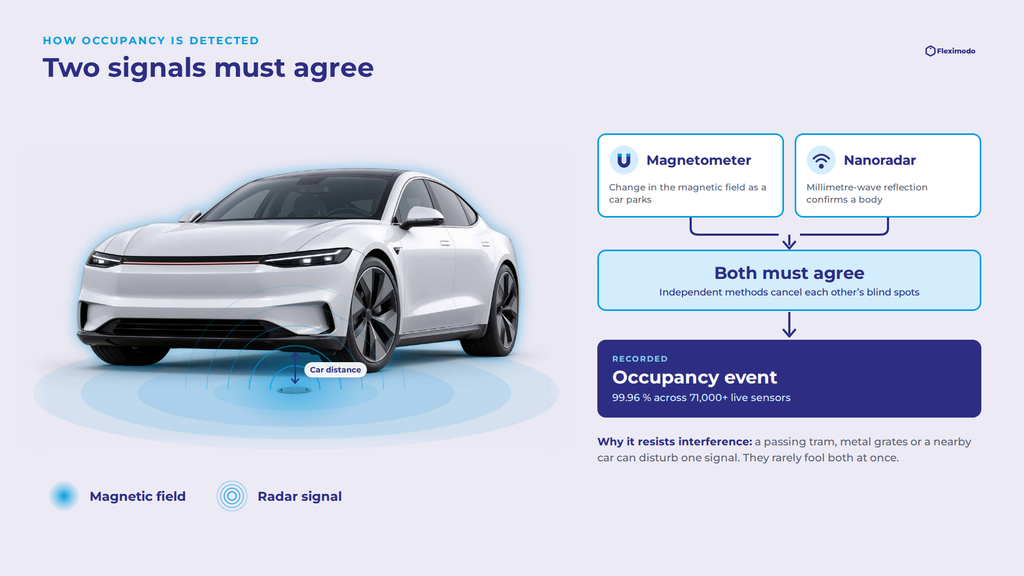
When a compact, low-power nano-radar became available, we began pairing it with the magnetometer. The radar confirms a physical body above the sensor with a millimeter-wave reflection, and it handles movement and short events that the magnetometer alone struggles with. Because the two methods are independent, each covers the other’s blind spots, and both must agree before an event is recorded. In our parking sensor accuracy testing, this pairing is what closed the gap left by the magnetometer.
“Reaching this level of accuracy was a turning point,” says Bohdan, who leads Business Development at Fleximodo. “When we started talking to cities and commercial clients, the feedback was clear. They need this level of reliability to roll out smart parking with confidence, and now we can give them that.”
The result: from 99.29 percent in testing to 99.96 percent at scale
In the ViCheP parking sensor accuracy testing study, run across more than 50,000 real-world parking events, the dual-sensor system reached a verified 99.29 percent. In production since, refined and measured across more than 71,000 live sensors in the field, accuracy has reached 99.96 percent.
The gap between those numbers and a single-sensor result is not cosmetic. In a 1,000-space deployment, the difference between 95 and 99.96 percent is the difference between dozens of wrong readings at any moment and fewer than one. Wrong readings mean false enforcement alerts, misdirected guidance signs and occupancy data a city cannot trust. Accuracy is what makes the rest of a smart parking system safe to act on.
Why parking sensor accuracy matters
A parking sensor is only as useful as the data it produces. Guidance, enforcement, pricing and planning all inherit the sensor’s error rate, so a fraction of a percent at the sensor compounds across a whole city. That is why our parking sensor accuracy testing uses video rather than a lab figure, and why we kept refining until the number held up in the real world.
For the headline figures, read our overview of parking sensor accuracy. See how the detection works in our guide to how parking sensors work, compare the networks in NB-IoT vs LoRaWAN, or explore the IoT parking sensors themselves.
FAQ
How accurate are Fleximodo parking sensors?
Fleximodo sensors detect occupancy at 99.96 percent accuracy, measured across more than 71,000 live sensors. A magnetometer and a nano-radar confirm each event together, which keeps the reading reliable even in interference-heavy sites.
How is parking sensor accuracy measured?
By comparing sensor data against reality, event by event. Fleximodo built a tool called ViCheP that overlays sensor positions on video of the car park, so a hand-logged record of every real event can be compared with what each sensor reported. The verification ran across more than 50,000 parking events.
What is ViCheP?
ViCheP (Video Check Portal) is Fleximodo’s internal web application for validating sensor accuracy. It maps sensor positions onto parking-lot video, so the team can see exactly where an error happened and why.
Why combine a magnetometer and a nano-radar?
A magnetometer alone reaches around 95 percent accuracy and can be fooled by interference or quick events. Adding a nano-radar gives a second, independent confirmation, so the two methods cover each other’s weaknesses and lift accuracy to 99.96 percent.
Does higher accuracy actually matter at city scale?
Yes. In a 1,000-space deployment, moving from 95 to 99.96 percent cuts wrong readings from dozens at any moment to fewer than one. That is the difference between enforcement and guidance a city can trust and data it cannot.
