by Mia Ilavska
October 2, 2026
Dynamic Parking Pricing: How Demand-Based Parking Works
The right price for a parking space is the one that keeps a few spots always free. That is dynamic pricing, and it only works if you can measure occupancy. Here is how demand-based parking actually runs.
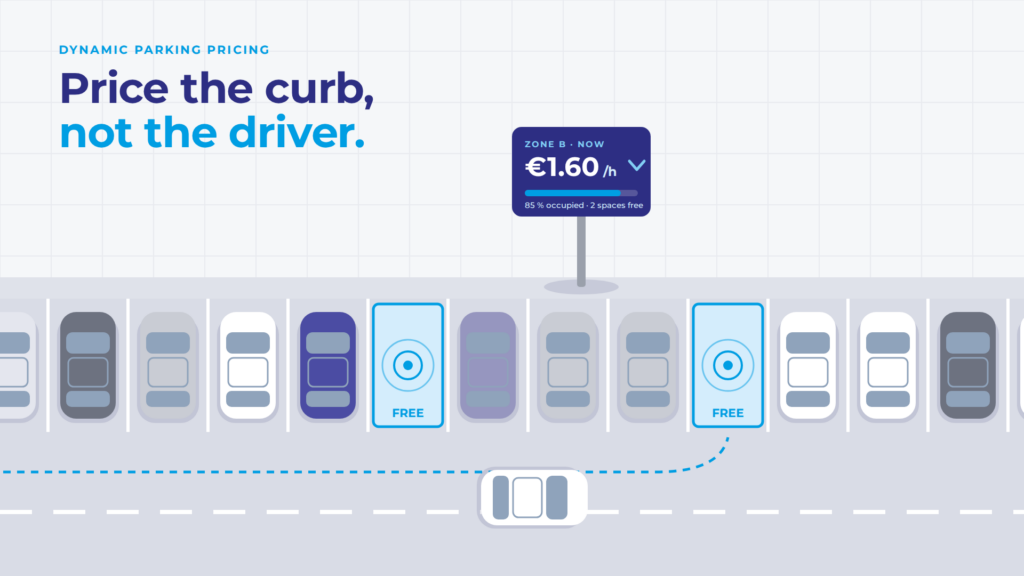
Table of content
What dynamic pricing actually does
Dynamic pricing adjusts parking rates by time and place to hit a target occupancy, usually around 85 percent. At that level, roughly one space per block is free at any time, so a driver can always find one without a long search. The price is a tool to manage demand, not a revenue grab. In quiet zones it drops to attract use; in packed zones it nudges up until the block breathes again.
This is the Shoup principle in practice, and cities from San Francisco to Seoul have tested versions of it. More recently, transit operators like BART have made demand-based parking pricing routine.
Why it needs occupancy data
Dynamic pricing without occupancy data is just guesswork on a schedule. To set the price by demand, you have to know demand, space by space, in real time. That is where an IoT parking sensor comes in: it reports occupancy at 99.96 percent accuracy, so pricing rules respond to what is actually happening on the street rather than a fixed timetable. Payment data alone cannot do this, because it sees payers, not occupancy. See smart parking vs parking meters.
It is not surge pricing
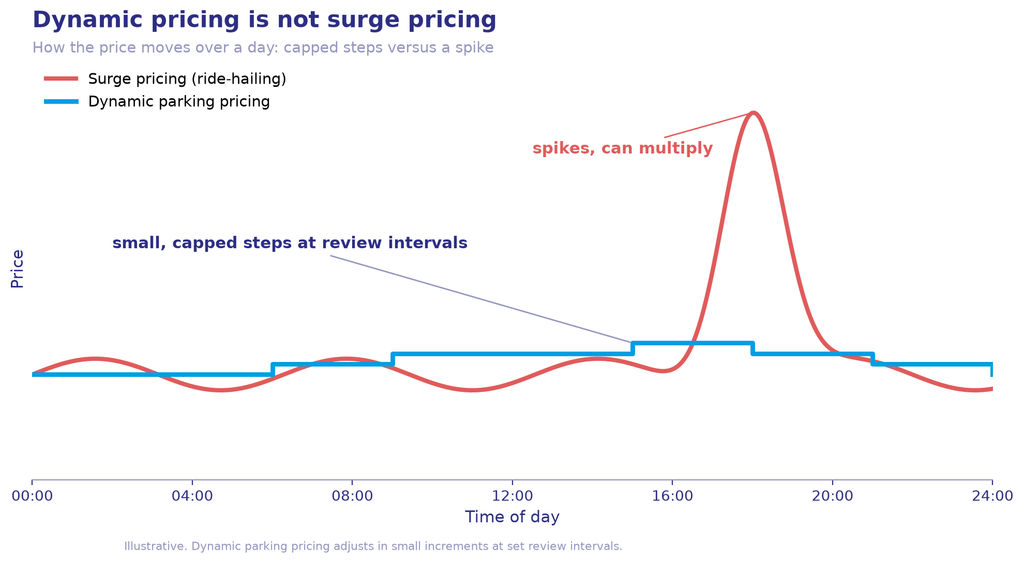
Dynamic parking pricing is often confused with ride-hailing surge pricing, and the difference is what makes it politically workable. Surge pricing changes minute to minute and can multiply. Demand-based parking pricing moves in small, capped steps at set review intervals, not in real time at the meter. SFpark, for example, adjusted rates gradually and by small increments, reviewed periodically rather than continuously, and BART changes station fees in modest steps to nudge occupancy. So a driver never faces a shock price; the rate for a block drifts slowly toward the level that keeps a space or two free.
That distinction matters for public acceptance. A predictable rate that changes a little each season is a very different thing from a price that spikes because a concert let out.
The cost of what it fixes
The problem dynamic pricing targets is bigger than it looks. Reviewing 16 cruising studies conducted between 1927 and 2001 across 11 cities on four continents, Donald Shoup found that cruising for parking made up between 8 and 74 percent of local traffic, an average of about 34 percent, with drivers taking an average of eight minutes to find a curb space. In one classic study of the Westwood Village business district in Los Angeles, that cruising added up to roughly 950,000 excess vehicle miles in a single year, wasting about 47,000 gallons of fuel and producing some 730 tons of CO2. Underpriced curb parking is what causes that cruising, because a space that is too cheap is always full, so the next driver has to circle. Pricing to availability is the direct fix.
Dynamic parking pricing in the real world
Dynamic pricing is not a theory; several cities have run it at scale. San Francisco's SFpark was one of the first large programs, adjusting meter rates block by block toward a target occupancy. Notably, pricing to availability often means lowering the price: across the pilot, average meter rates actually fell, by about 4 percent, because many streets were overpriced for their real demand. The time drivers spent searching dropped by 43 percent, and cruising fell by half.
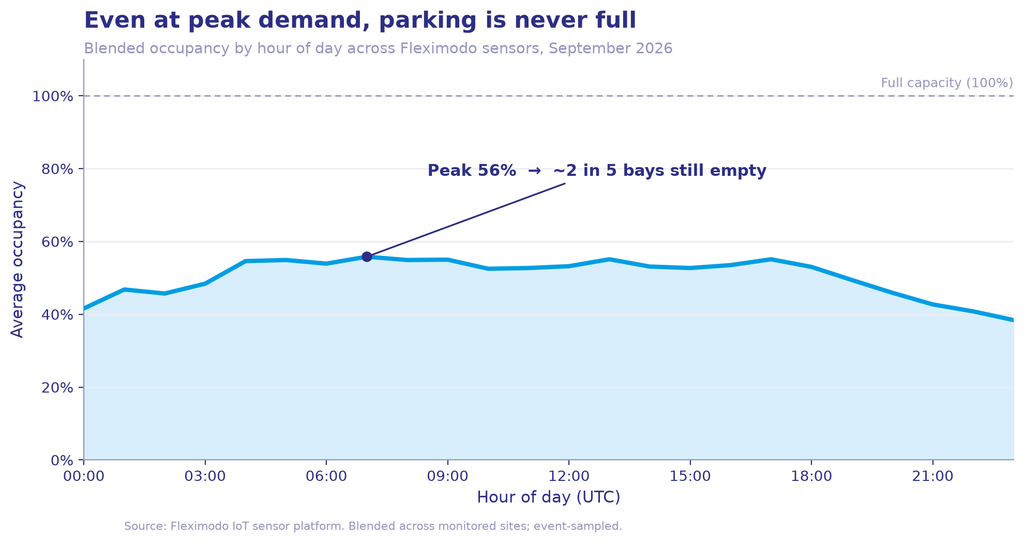
Our own data points the same way. Across the Fleximodo bays reporting in September 2026, blended occupancy peaked at about 56 percent and sat lower for most of the day, well under the 85 percent that pricing aims for. When blocks are that far below target, pricing to availability usually means holding or lowering the rate, not raising it.
Los Angeles followed with LA Express Park, adjusting downtown meter rates by measured demand, where again a large share of the changes were price decreases. And in transit, BART adjusts station parking fees in small increments to keep lots near full but not overflowing, so a commuter can still find a space.
The model travels beyond the US, too. Calgary's ParkPlus system prices on-street parking by block based on demand, one of the longest-running demand-responsive programs outside the US. Madrid ties its regulated on-street pricing (SER) to the vehicle, charging more for higher-emission cars, which folds dynamic pricing into a low-emission-zone strategy rather than treating them separately. And event-driven pricing is now common around stadiums and venues, where rates rise for a match or concert and fall back afterwards, smoothing the surge that would otherwise gridlock the surrounding streets. The common thread across all of them is that none could work without accurate, space-level occupancy data.
The payoff: less circling, less congestion
When pricing keeps a few spaces free, drivers stop cruising for parking, and cruising is a large, hidden source of city traffic: in Shoup's review it ran as high as 74 percent of local traffic, about a third on average. Dynamic pricing attacks that at the source, which is why it sits at the center of the Parking Paradox: the fix for a "full" city is rarely more parking, it is pricing and data that make the existing curb usable. See how the wider picture works in traffic congestion solutions.
FAQ
What is dynamic parking pricing?
Dynamic parking pricing sets parking rates by real-time demand instead of a fixed rate. Prices rise slightly where demand is high until spaces free up, and fall where demand is low. The aim is a target occupancy of around 85 percent, so drivers can always find a space quickly.
How does dynamic parking pricing work?
Sensors measure occupancy per space in real time. Pricing rules then adjust rates by zone and time to keep occupancy near a target of about 85 percent. When a zone fills, the price nudges up until a few spaces open; when it empties, the price drops to attract drivers.
Does dynamic pricing just make parking more expensive?
No. It raises prices only where demand is high and lowers them where demand is low, with the goal of availability, not revenue. Many zones get cheaper. In San Francisco's SFpark, average meter rates actually fell about 4 percent. The point is to keep a few spaces free so drivers stop circling.
What does dynamic parking pricing require?
Accurate, real-time occupancy data. Without knowing how full each zone is, pricing cannot respond to demand. IoT sensors provide that at 99.96 percent accuracy; payment data alone is not enough because it only records payers, not actual occupancy.
Is dynamic parking pricing the same as surge pricing?
No. Surge pricing changes minute to minute and can multiply during a spike. Dynamic parking pricing moves in small, capped steps at set review intervals, so the rate for a block drifts slowly rather than jumping. That predictability is what makes it publicly acceptable, unlike a price that spikes when a concert ends.
Where has dynamic parking pricing been used?
San Francisco (SFpark), Los Angeles (LA Express Park), Calgary (ParkPlus), and Madrid (emissions-linked SER) have all run demand-based on-street pricing, and transit operators such as BART use it for station lots. Event-driven pricing around stadiums is now common too. The common requirement across all of them is reliable, space-level occupancy measurement.
