by Mia Ilavska
October 6, 2026
Fleximodo vs Urbiotica: IoT Parking Sensor Comparison
A fair, side-by-side comparison of Fleximodo and Urbiotica IoT parking sensors: detection architecture, verified accuracy, connectivity, ecosystem and deployment scale.
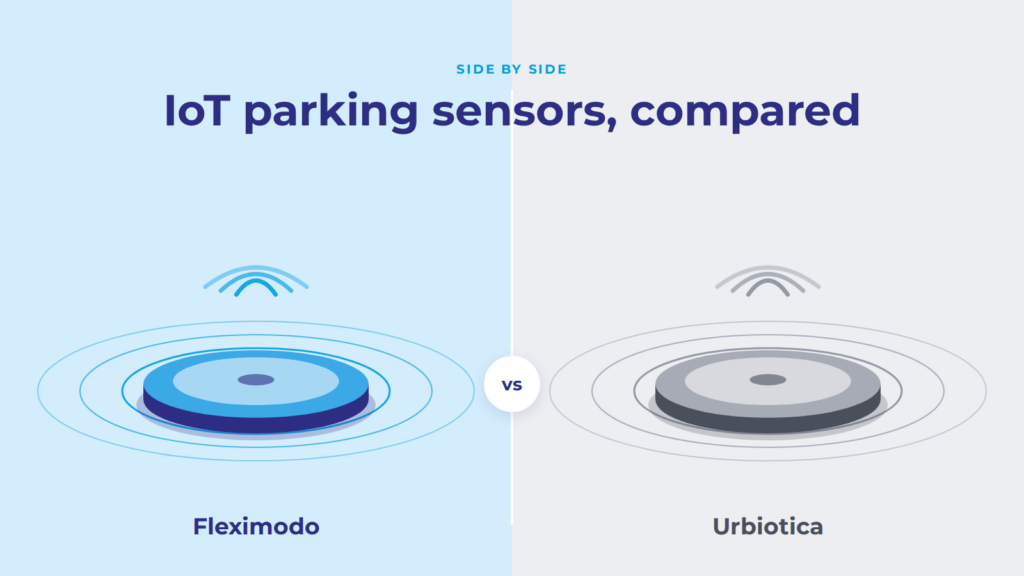
Table of content
Fleximodo vs Urbiotica: side-by-side comparison
| Fleximodo | Urbiotica (U-Spot 3.0) | |
|---|---|---|
| Sensor type | Flush, single-space, autonomous | Flush, single-space, autonomous |
| Detection | Magnetometer + nanoradar (dual hardware sensing) | Magnetic detection with cloud-side filtering |
| Verified accuracy | 99.96% across 71,000+ live sensors | High; relies on cloud calibration and noise filtering |
| Battery life | Up to 10 years | Around 10 years |
| Connectivity | NB-IoT, LoRaWAN, Sigfox, LTE-M | NB-IoT, LoRaWAN (+ BLE for maintenance) |
| Operating temperature | -40 to +85 C | -40 to +85 C |
| Weather resistance | Sealed, unaffected by snow, water, dust | Unaffected by snow, water, dust |
| Ecosystem | Sensors, flip-dot signage, permits, ANPR, CityPortal platform | Parking detection portfolio and platform |
| Scale | 71,000+ sensors, 50+ countries | Established EU deployments |
Detection: dual hardware sensing vs magnetic plus cloud filtering
The clearest architectural difference in Fleximodo vs Urbiotica is detection. Fleximodo combines two hardware signals in the sensor itself: a magnetometer measures the change a vehicle makes in the magnetic field, and a nanoradar confirms a physical body is above the sensor. Because two independent methods must agree, edge cases that fool one are caught by the other, which is how Fleximodo reaches a verified 99.96% accuracy across 71,000+ live sensors.
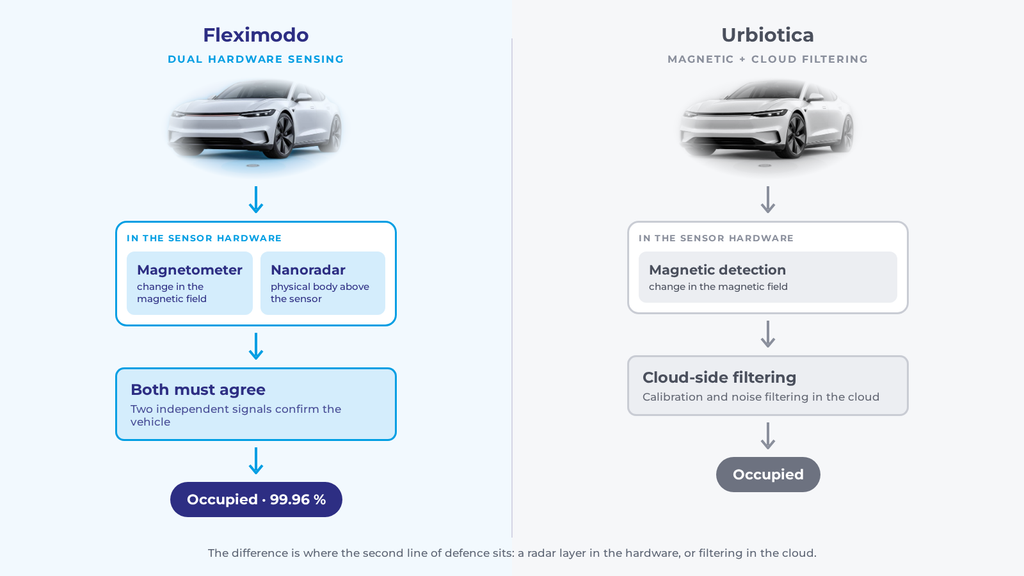
Urbiotica's U-Spot uses magnetic detection with cloud-side calibration and filtering to discriminate electromagnetic interference and false events. It is a proven approach that handles weather well. The distinction is where the second line of defense sits: in Fleximodo's case it is a radar layer in the hardware; in Urbiotica's it is filtering in the cloud. For the detail on dual sensing, see how parking sensors work and parking sensor accuracy.
Installation and battery life
Both sensors install flush in the bay and run autonomously without cabling, and both are rated for roughly a 10-year battery life, so on power and installation they are closely matched. Real-world battery life depends on reporting frequency and temperature, so model the exact figures for your conditions rather than the headline number. For a large deployment, ask each vendor for the expected life at your reporting interval and climate.
Connectivity and environment
On connectivity and environment, the two are closely matched. Both support NB-IoT and LoRaWAN, so both can ride a carrier network or a gateway you own, and both operate from -40 to +85 C. Urbiotica adds a Bluetooth module for local maintenance and configuration; Fleximodo also supports Sigfox and LTE-M for wider network flexibility. For most projects, connectivity will not be the deciding factor between these two. If you are weighing the networks themselves, see NB-IoT vs LoRaWAN.
Beyond the sensor: the wider system
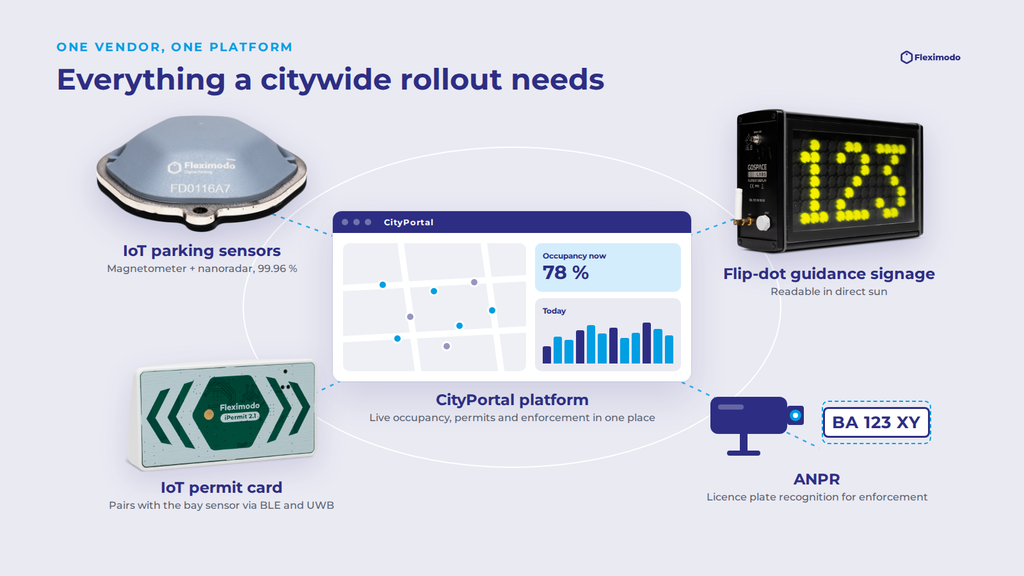
Where Fleximodo vs Urbiotica diverges again is breadth of ecosystem. Fleximodo ships the surrounding layers a full deployment needs: flip-dot guidance signage that stays readable in direct sun, digital permit cards, ANPR, and the CityPortal platform, all from one vendor. If your project is only in-ground detection, that breadth may not matter. If it is a citywide rollout with guidance, permits, and enforcement, sourcing it from one platform reduces integration risk.
Deployment scale and track record
Both vendors have real European deployments. Fleximodo's referenceable scale is 71,000+ sensors across 50+ countries, with named citywide rollouts such as Pardubice (3,421 sensors) and Roma Capital (19,000-sensor rollout). When you evaluate any vendor, ask for named, callable references at a scale similar to your project, because a pilot reference and a citywide reference are not the same signal.
Fleximodo vs Urbiotica: when to choose each
- Choose Fleximodo when you want dual-hardware detection with a published 99.96% accuracy and a single platform for sensors, signage, permits, and enforcement at city scale.
- Choose Urbiotica when you want a proven flush magnetic sensor with cloud-side filtering and dual-network connectivity, and their parking detection portfolio and ecosystem fit your project.
The honest rule is the same as for any comparison: match the sensor and the surrounding system to the site, and hold both vendors to verified numbers and named references.
FAQ
What is the difference between Fleximodo and Urbiotica parking sensors?
Both are flush, single-space IoT parking sensors on NB-IoT and LoRaWAN. The main differences are detection architecture (Fleximodo uses a magnetometer plus a nanoradar in hardware; Urbiotica uses magnetic detection with cloud-side filtering), published detection accuracy, and ecosystem breadth and scale.
Which is more accurate, Fleximodo or Urbiotica?
Fleximodo publishes a verified 99.96% detection accuracy across 71,000+ live sensors, achieved by combining a magnetometer with a nanoradar. Urbiotica relies on magnetic detection with cloud calibration and noise filtering. Ask each vendor for a verified accuracy figure and the method behind it.
Do both support NB-IoT and LoRaWAN?
Yes. Both Fleximodo and Urbiotica's U-Spot support NB-IoT and LoRaWAN, so either can run on a carrier network or a gateway you operate. Fleximodo additionally supports Sigfox and LTE-M, and Urbiotica includes Bluetooth for local maintenance.
How long do the batteries last?
Both are rated for roughly a decade on a single battery: Fleximodo up to 10 years, and Urbiotica around 10 years. Real-world life depends on reporting frequency and temperature, so ask each vendor for the expected life at your reporting interval and climate before a large deployment.
Is Fleximodo a good Urbiotica alternative?
For projects that need dual-hardware detection, a published 99.96% accuracy, and a single vendor for sensors, guidance signage, permits, and enforcement at city scale, Fleximodo is a direct alternative. Both are credible European vendors, so compare on verified accuracy, ecosystem, and named references at your scale.
