by Mia Ilavska
September 29, 2026
Car Park Sensors: How to Choose the Right Ones for Surface, Multi-Storey and Underground Car Parks
The right car park sensor depends on the structure it goes into, not on the brochure. This guide covers surface, multi-storey and underground car parks, and the site checks that decide accuracy.
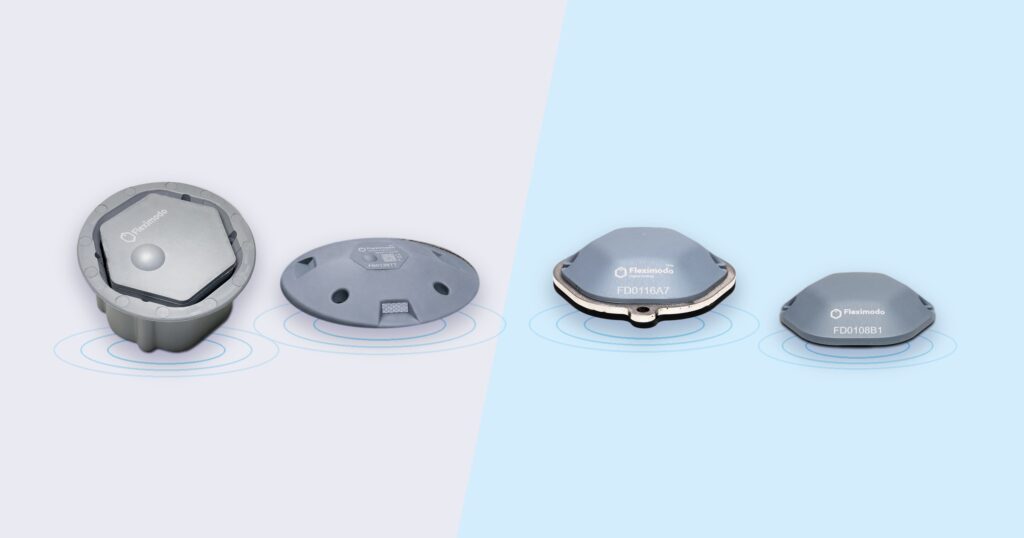
Table of content
What do car park sensors actually do?
Car park sensors detect whether each individual parking space is occupied or free and report every change to a software platform in real time. That live data then drives guidance signs, driver apps, enforcement alerts and occupancy reports. The sensor itself is small. The value is what the data lets an operator do.
There are two ways to count parking. Entry and exit counters at the barrier tell you how many cars are inside. Bay-level sensors tell you exactly which spaces are free. Counters are cheaper if you only need a total on a sign at the entrance. Bay-level sensors earn their cost when drivers need directing to a specific level or row, when reserved or accessible bays need protecting, or when you want to know how each space is really used.
Fleximodo IoT parking sensors combine two detection methods, a magnetometer that reads the change in the magnetic field when a car arrives and a nanoradar that confirms something is physically above the sensor. Using both is how the system reaches 99.96% detection accuracy.
Which sensor suits a surface car park?
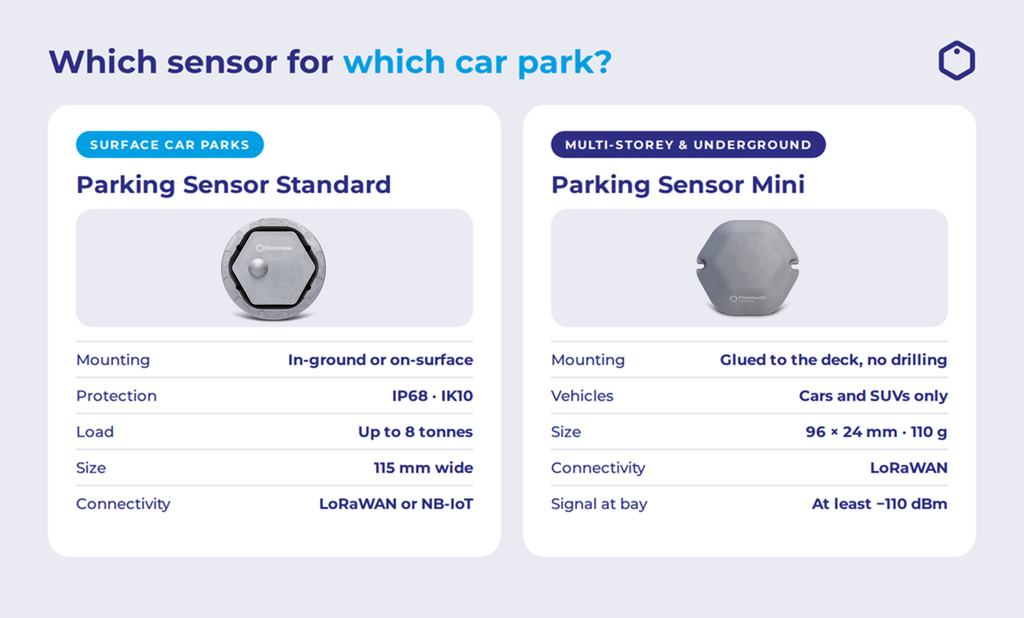
For open-air car parks, use a full-size outdoor sensor built for traffic, weather and winter maintenance. At Fleximodo that is the Parking Sensor Standard: IP68 sealed, IK10 impact rated, 115 mm wide and able to take a load of up to 8 tonnes. It connects over LoRaWAN or NB-IoT, so no cabling is needed.
Surface car parks give you two mounting options:
- In-ground. The installer core-drills a hole 100 mm wide and at least 60 mm deep, sets the sensor in its mount and seals it flush with the surface. It is the most durable option. Because it sits flush, it is less exposed to sweepers and snow ploughs, although plough drivers should still know where the sensors are.
- On-surface. The sensor sits in an adaptor about 300 mm wide that is glued or bolted to the surface. No drilling into the asphalt is needed, which suits sites where the owner does not want the surface cut, or temporary and pilot installations. The adhesive needs 24 hours to cure before cars drive over it.
Block paving works too. The installer lifts enough bricks to seat the mount, or casts the housing into a replacement brick, so the sensor sits level and cannot move.
Which sensor suits a multi-story or underground car park?
Indoors, a smaller and lighter sensor is usually the better fit. The Fleximodo Parking Sensor Mini is 96 mm wide, 24 mm high and weighs 110 g. On a dry, solid, flat deck it can be glued in place, often with no drilling at all. That matters in structured parking, where drilling into a post-tensioned slab is something building owners want to avoid.
The Mini is built for passenger cars and SUVs. It is not meant for buses, trucks or heavy machinery, and for outdoor kerbside bays we recommend the Standard sensor instead. Picking the Mini for a truck yard to save money is a false economy.
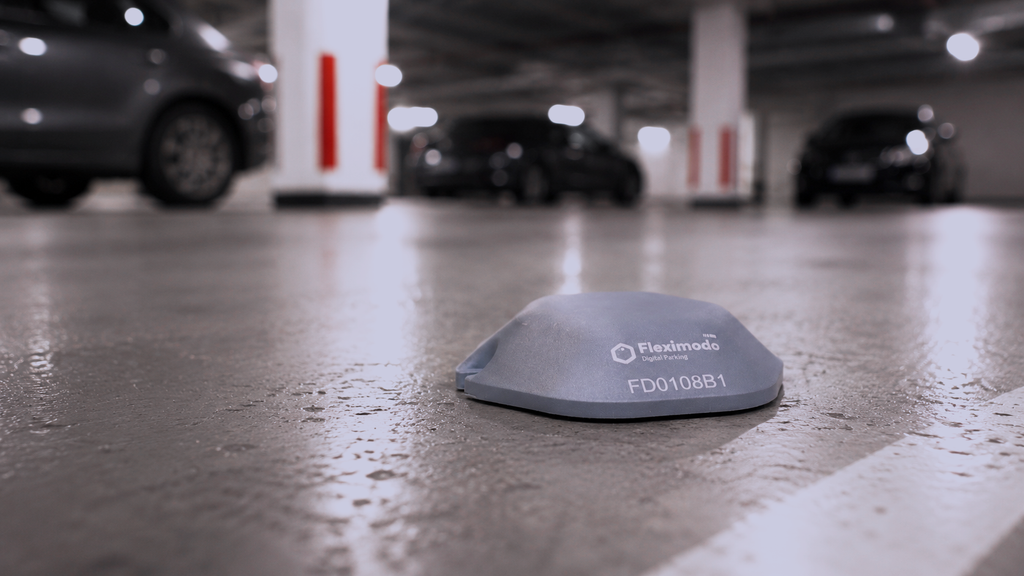
Radio signal needs more planning underground than on the surface. Concrete decks and ramps weaken signal, so the Mini connects over LoRaWAN, where you can place gateways exactly where coverage is needed. We ask for a LoRa signal of at least -110 dBm at each bay, and the installer checks it on the spot with the DiSPO service app before fixing anything down.
What affects accuracy once the sensors are installed?
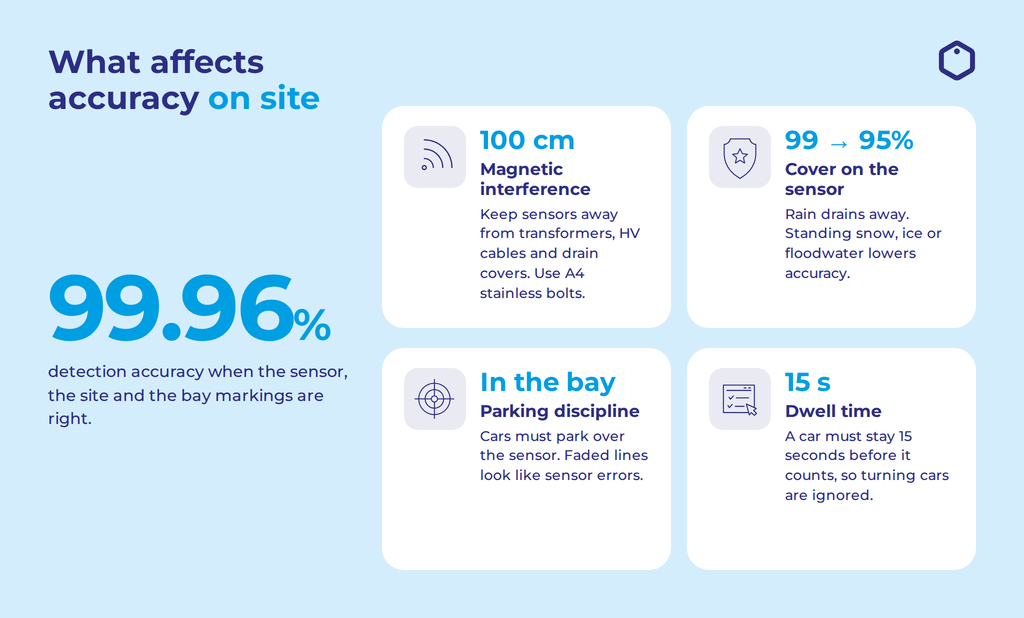
Accuracy depends as much on the site as on the sensor. A good sensor in a poor spot will underperform. These are the conditions we check on every project:
- Magnetic interference. Transformers, high-voltage cables and large metal objects such as drain covers disturb the magnetic reading. Keep sensors at least 100 cm from large metal objects, and use non-magnetic stainless steel (A4) bolts.
- Cover. Rain is not a problem if the water drains away. Snow, ice or floodwater sitting on top of the sensor can lower accuracy from about 99% to about 95%.
- Parking discipline. Cars need to park inside the marked bay and over the sensor. Faded markings or fresh snow over the lines can cause mis-parking that looks like a sensor error.
- Dwell time. A car has to stay for at least 15 seconds before the system reports it. That filters out vehicles that pull in briefly to turn round.
Sensors calibrate themselves during normal use. To speed up commissioning, the installer parks over each sensor for more than 30 seconds, then leaves the bay empty for more than 30 seconds.
Car park sensors or cameras?
Sensors are the better choice for bay-level occupancy in most car parks, and cameras are the better choice when you need plate numbers or photo evidence. A single camera covers many bays but needs power, a clear line of sight and good lighting, and it processes images of vehicles, which brings GDPR obligations. A sensor detects a magnetic field, not a person or a plate.
Many sites use both: sensors on the bays, a camera at the barrier. We compare the two in more detail in parking sensors vs cameras.
What should you do with the data?
Occupancy data pays off when it changes what drivers and staff do. The most direct use is guidance: a sign at each decision point, such as a ramp or level entrance, showing how many spaces are free ahead. Fleximodo parking guidance signage uses flip-dot displays, which stay readable in direct sunlight and draw power only when the number changes, so they can run on solar power without cabling.
Three deployments show the range:
- SSMC, Abu Dhabi. A hospital car park with 1,750 sensors, where visitors and staff need to find a space quickly.
- JHAH, Saudi Arabia. Around 1,700 spaces guided by roughly 60 flip-dot displays, installed in 2024.
- Pradiarňa, Bratislava. An indoor corporate car park with 10 spaces and 5 displays. Proof that bay-level data is useful at small scale too.
Behind the signs, the same data feeds dashboards that show which bays are used, for how long and at what times. That helps an operator decide whether a car park is really full or only full on one level at 9 am.
A checklist before you order
Walk the site with these questions before you choose a sensor:
- Is the car park open-air, multi-story or underground, or a mix?
- Can the surface be drilled, or does it need adhesive or bolted mounting?
- What vehicles use it: cars only, or vans and trucks as well?
- Is there NB-IoT coverage at bay level, or will you need LoRaWAN gateways?
- Where are the transformers, power cables and large metal objects?
- Who acts on the data: drivers through signs, staff through dashboards, or enforcement?
- Do reserved, staff or accessible bays need to know who is parked, not only that a car is there?
If question 7 is a yes, pair the sensors with digital parking permits. The fastest way to answer the rest is to test on your own site. Our Demo-Kit lets you install a few sensors and see real data before committing to a full rollout.
FAQ
What are car park sensors?
Car park sensors are small devices fitted to individual parking bays that detect whether a vehicle is present and report each change to a software platform in real time. The data drives guidance signs, apps, enforcement alerts and occupancy reports. Fleximodo sensors combine a magnetometer and a nanoradar to reach 99.96% detection accuracy.
Which car park sensor is best for an underground car park?
A compact sensor designed for indoor use, with LoRaWAN connectivity so gateways can be placed where the concrete blocks signal. The Fleximodo Parking Sensor Mini is 96 mm wide and 24 mm high and can often be glued to the deck without drilling. Check signal strength at each bay before installation.
Do car park sensors need cabling?
No. Wireless IoT car park sensors run on internal batteries and send data over LoRaWAN or NB-IoT, so there is no trenching or power cabling. Installation takes a core drill for in-ground mounting, or adhesive or bolts for surface mounting.
How accurate are car park sensors?
Well-installed dual-sensing sensors reach 99.96% detection accuracy in Fleximodo deployments. Accuracy drops when snow, ice or floodwater covers the sensor (to about 95%), when the magnetic environment is unstable, or when drivers park outside the marked bay.
Can car park sensors detect trucks?
Yes, with the right hardware and firmware. The full-size Fleximodo Standard sensor takes loads of up to 8 tonnes and runs a dedicated truck firmware that relies on radar only, because trucks sit much higher above the sensor than cars. Compact indoor sensors such as the Mini are designed for cars and SUVs only and should not be used under trucks or buses.
Should I use sensors or cameras in a car park?
Use sensors for bay-level occupancy and cameras for plate recognition or photo evidence. Sensors need no line of sight or lighting and do not capture images, which simplifies GDPR compliance. Many car parks combine sensors on the bays with a camera at the barrier.
