by Mia Ilavska
October 12, 2026
Parking Management Software: 2026 Buyer’s Guide for Operators and Cities
What parking management software does, how to compare systems, what it costs, and the questions to ask before you buy. Occupancy, permits, payments, enforcement, analytics.
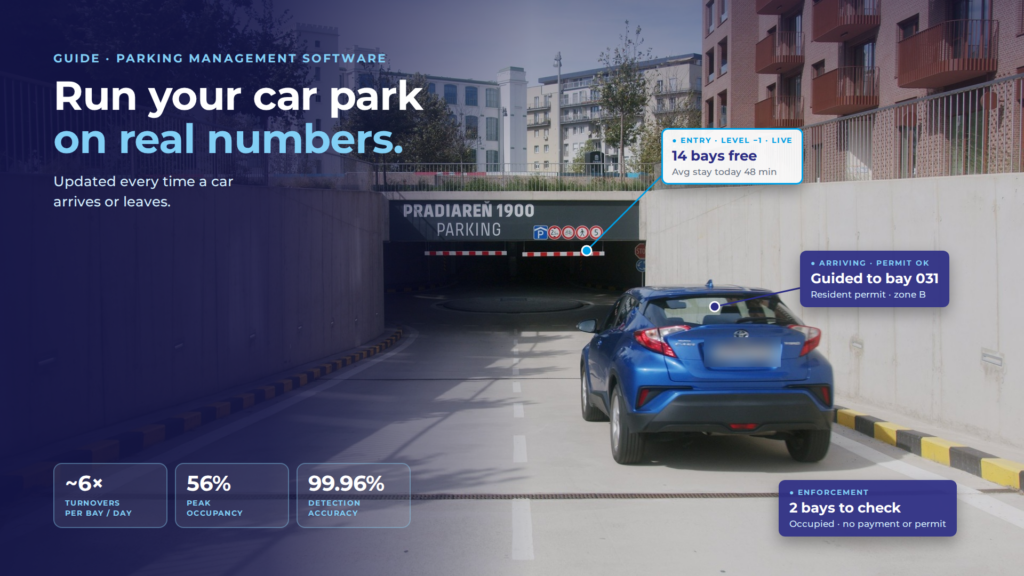
Table of content
Key takeaways
- A complete system does six jobs: occupancy, guidance, permits, payments, enforcement and analytics. Many products cover two or three.
- Everything downstream inherits the accuracy of the occupancy data, so judge the sensor layer before the dashboard.
- The return comes from recovered revenue and from parking spaces you no longer need to build.
- Ask for named references at your scale, an open API and clear data ownership before you sign.
What is parking management software?
Parking management software is the cloud layer that brings every parking space into one system and makes the data useful. It sits on top of the hardware (sensors, cameras, barriers, payment terminals) and connects the pieces: it knows which bays are free, who paid, who is allowed to park, and how the site is used over time.
People call it different things. “Parking management software”, “parking management system”, “parking solutions” and “software for parking management” all describe the same category from slightly different angles. Hardware vendors lead with sensors, software vendors lead with the dashboard. The job is the same: replace guesswork with evidence.
What parking management software actually does
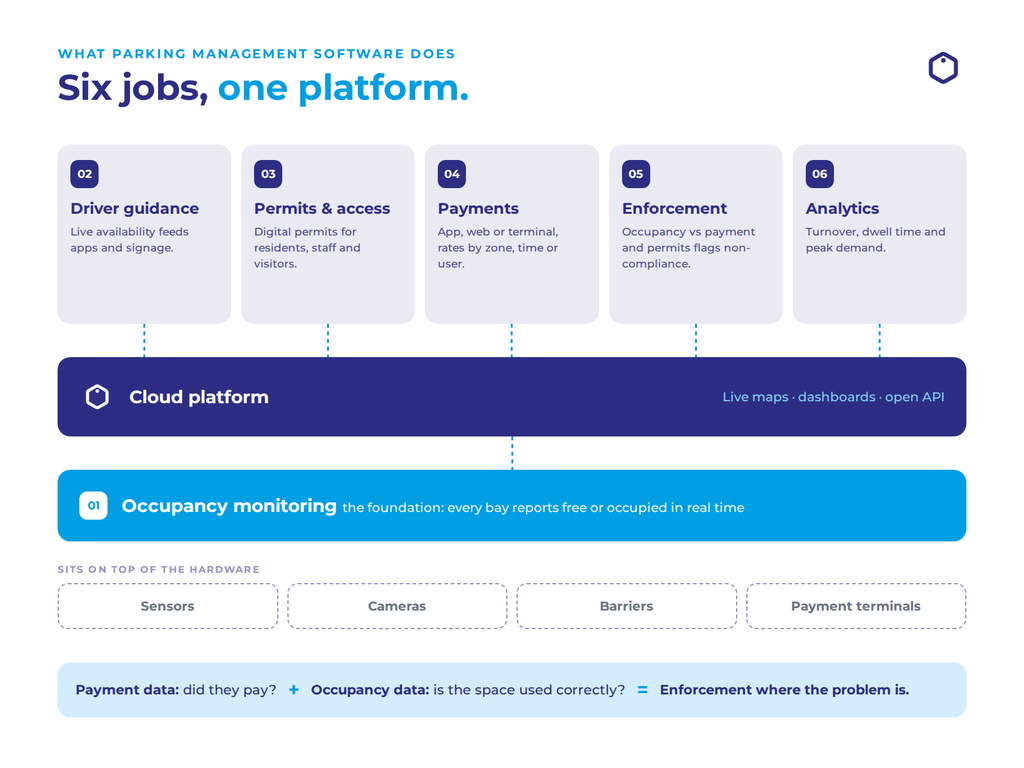
A complete parking management system covers six jobs. Weaker systems do two or three of them and leave the rest to spreadsheets.
- Occupancy monitoring. Per-space sensors report whether each bay is free in real time. This is the foundation. Without it, everything else is an estimate.
- Driver guidance. Live availability feeds apps and signage, so drivers go straight to a free bay instead of circling.
- Permits and access. Digital permits for residents, staff and visitors, so the system knows who is entitled to park where.
- Payments. Pay by app, web or terminal, with different rates by zone, time or user group.
- Enforcement. The system compares occupancy against payments and permits and flags non-compliance, so officers go where the problem actually is.
- Analytics. Turnover, dwell time and peak demand, used for pricing, capacity planning and reporting.
The value is in the loop. Payment data answers “did they pay?” Occupancy data answers “is the space being used correctly?” Together they turn a car park from a black box into a managed system.
Who uses parking management software?
The software is the same. The problem it solves changes with the buyer.
- Cities and municipalities use it to manage on-street zones, residential permits and accessible bays, and to close the gap between what parking should earn and what it collects.
- Car park operators use it to raise occupancy, guide drivers in and price by demand across many sites from one dashboard.
- Commercial property and corporate campuses use it to share a fixed number of spaces among more employees and tenants, instead of building more.
- Logistics and motorway operators use it to monitor truck bays at rest areas, where drivers need to know about a free space before they arrive.
Cloud or on-premise?
Most modern parking management software is cloud based, and for good reason. A cloud platform aggregates every site in real time, stores history for analysis, exposes an API for city portals and third-party apps, and needs no on-site server to maintain. An operator checks any site from any device. On-premise still appears in high-security or air-gapped environments, but for cities and commercial operators the cloud model is now standard.
How to compare parking management systems
The category is crowded, and the demos all look similar. These criteria separate systems that work at scale from systems that demo well.
- Accuracy proven at scale. Ask for a verified detection figure and the method behind it. Fleximodo publishes 99.96 percent, measured across more than 71,000 live sensors in 51 countries, not in a lab.
- Existing infrastructure. NB-IoT sensors use the existing mobile network, with no gateways to deploy. That changes the cost of a rollout.
- Battery life. A sensor in the asphalt should last about 10 years. Every early battery swap is a lane closure and a truck roll.
- One platform or three integrations. Sensors, guidance, permits, payments and enforcement from one supplier carry less integration risk than a stitched-together stack. Fleximodo works as a one-stop shop: hardware, software and integration from one team.
- Privacy by design. Sensor-based occupancy records a vehicle in a space, not a person or a plate, which keeps it GDPR-friendly compared with camera-only systems. Fleximodo goes further: drivers can use their phone as a parking ID token to protect a reserved bay or pay, without plate recognition.
- Accessible parking. Check how the system handles disabled bays and permit checks, especially with the European Parking Card for persons with disabilities coming under Directive (EU) 2024/2841.
- Open API and white label. Your data should flow into a city portal, a mobile app or a third-party system, and dashboards, apps and signage should carry your brand, not the vendor’s.
What parking management software costs
There is no single price, because the total depends on how many bays you monitor and what hardware sits under the software. A realistic budget has four lines:
- Hardware. Per-space sensors, plus guidance signs, terminals or cameras where needed.
- Installation. Mounting sensors and signage, usually the shortest part of the project when no gateways or cabling are involved.
- Software subscription. Typically priced per space or per site, covering the cloud platform, apps and updates.
- Connectivity and support. Data plans for NB-IoT sensors, maintenance and the service level you need.
Compare offers on total cost of ownership over the sensor’s life, not on the unit price. A cheaper sensor that needs a battery swap after four years costs more than one that runs for ten.
What parking management software returns
The return usually comes from two places: recovered revenue and deferred construction.
On revenue, better compliance collects money a site is already owed. Pardubice digitised its municipal parking and grew parking revenue 74 percent with no tariff increase, driven by occupancy-based enforcement on top of payment. On capacity, utilisation data often shows the existing supply is not full, just badly distributed. That can defer building new spaces at 20,000 to 50,000 euro each. At Henkel’s Bratislava campus, 200 physical spaces were made to serve 600 employees through shared, data-driven allocation, with zero new construction.
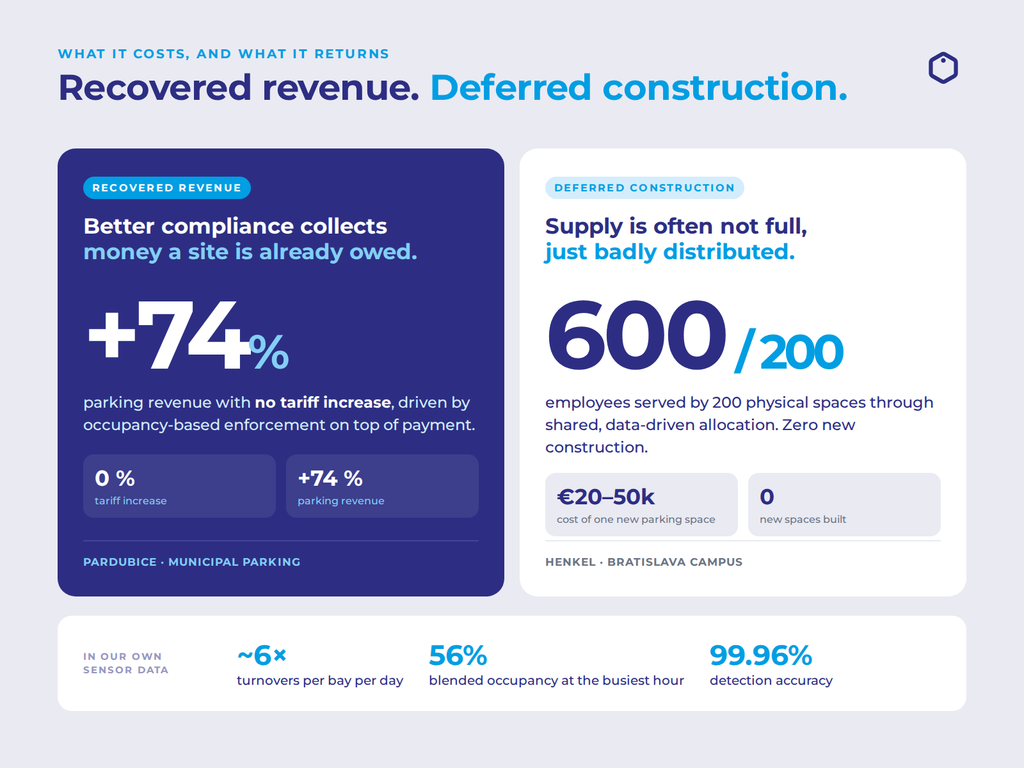
In our own sensor data, a monitored bay turns over about six times a day, and blended occupancy peaks at around 56 percent even at the busiest hour. Most places do not have a parking shortage. They have parking they cannot see.
Questions to ask before you buy
Take these into the vendor meeting. The answers tell you more than the demo.
- What is your detection accuracy, how was it measured, and on how many live sensors?
- Can you name a reference at our scale, and can we call them?
- Which of the six jobs does your platform cover natively, and which need a partner?
- Who owns the data, and can we export all of it if we leave?
- Which APIs are available, and what do they cost?
- What is the real battery life in the field, and who pays for replacements?
- What does a pilot look like, and what result would justify a full rollout?
- What service level do you commit to, and how fast do you fix a failed sensor?
How to roll it out: from pilot to citywide
Start with a pilot on one zone or one car park with a known problem, such as low compliance or constant circling. Measure a baseline for a few weeks, switch on enforcement or guidance, and compare. Then scale zone by zone on the same platform, so every new site adds data to one system instead of creating another silo.
Hardware and software work together
Software is only as good as the data under it. Guidance, enforcement, pricing and planning all inherit the occupancy layer’s accuracy, so a fraction of a percent at the sensor compounds across a whole site. That is why the strongest parking management solutions pair a reliable occupancy sensor with the software, rather than treating the dashboard as the whole product. For the full picture of how the layers fit together, see our guide to the digital parking management system, the IoT parking sensors that feed it, and how it plays out for a city on our municipal parking page.
FAQ
What is parking management software?
Parking management software is the cloud system that brings every parking space into one platform and uses the data to guide drivers, manage permits and payments, enforce rules, and analyse usage. It turns a car park from a black box into a measured operation.
What should parking management software include?
Six things: real-time occupancy monitoring, driver guidance, permits and access, payments, enforcement, and analytics. Many systems cover only part of that. The strongest cover all six from one platform with an open API.
How much does parking management software cost?
It depends on the number of bays and the hardware, with costs split between sensors, installation, a software subscription and connectivity. The return usually outweighs it: better compliance recovers revenue already owed (Pardubice grew revenue 74 percent with no tariff rise), and utilisation data can defer building spaces that cost 20,000 to 50,000 euro each.
Is parking management software GDPR-compliant?
Sensor-based systems record a vehicle in a space, not a person or a licence plate, so they process no personal data at the sensor. That makes them more privacy-friendly than camera-only systems. Check any vendor against the GDPR for the parts of the system that do handle personal data, such as permits and payments.
Cloud or on-premise parking management software?
Cloud is now standard for cities and commercial operators: real-time aggregation across sites, history for analysis, an API for integrations, and no on-site server to maintain. On-premise is reserved for high-security or air-gapped cases.
How long does it take to deploy a parking management system?
A pilot on one zone can run within weeks when sensors use the existing mobile network and need no gateways. Citywide rollouts go zone by zone on the same platform.
